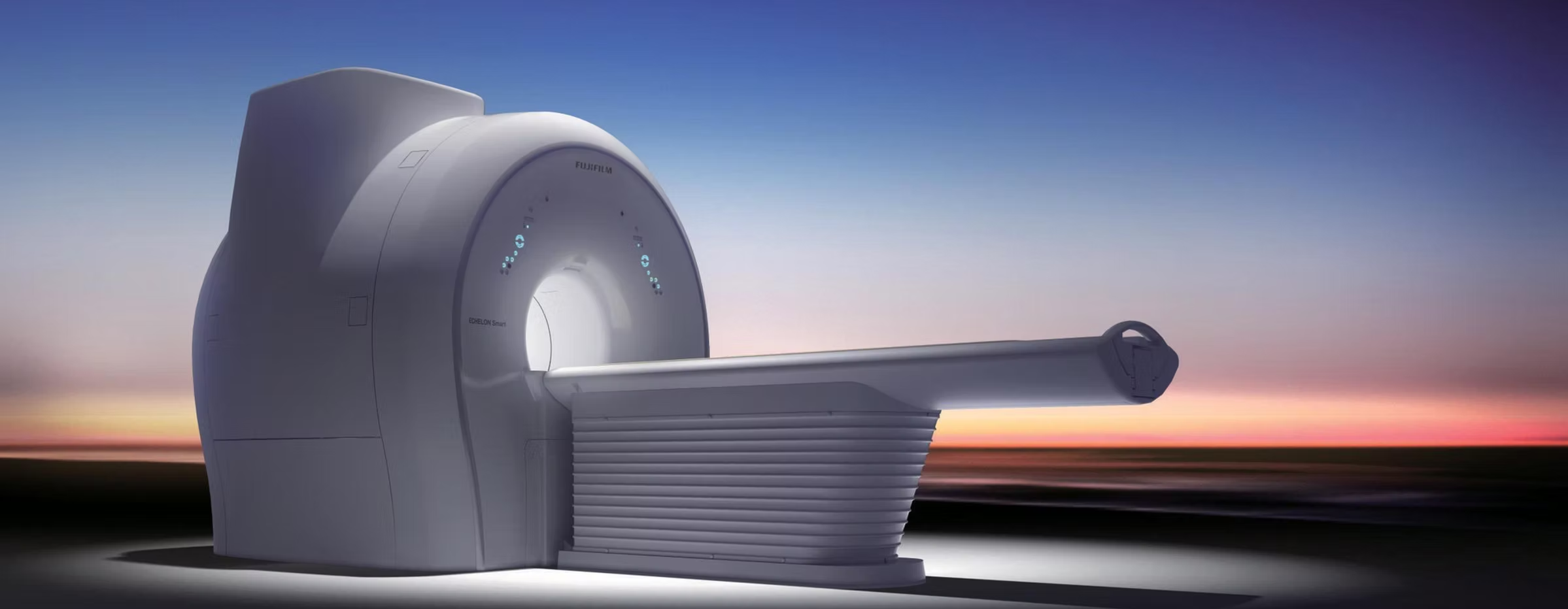
AV Scan Diagnostics in Dadar West / Prabhadevi, Mumbai, near Siddhivinayak Temple and Shivaji Park, performs knee MRI for ACL, meniscus, cartilage and other ligament injuries on a Fujifilm ECHELON Smart MRI with a wide bore, and for a knee scan you usually go in feet first. Knee MRI is reported by our panel of sub-specialty radiologists, with musculoskeletal imaging led by our MSK fellowship-trained radiologist, and most reports are ready the same day, sent to your WhatsApp.
At a Glance
| What it is | An MRI of the knee, made with a strong magnet and radio waves, not X-rays. It shows the ACL, PCL, collateral ligaments, menisci, cartilage and bone bruising, and is used before arthroscopy and after knee surgery |
|---|
| Scanner | Fujifilm ECHELON Smart MRI: a closed, wide-bore scanner with quieter scanning and in-scanner music |
|---|
| Reported by | Our panel of sub-specialty radiologists; musculoskeletal imaging is led by our MSK fellowship-trained radiologist |
|---|
| Time in the scanner | Usually about 30–40 minutes |
|---|
| Preparation | No fasting for a non-contrast knee MRI; if contrast is needed (rare for the knee), about 4 hours without food. Remove metal and jewellery near the knee, and tell us about implants, previous knee surgery or a pacemaker before booking. Our team confirms the exact preparation when you book on WhatsApp |
|---|
| If you are anxious | Usually feet first, so your head usually stays near the opening or outside the scanner; wide bore and in-scanner music; sedation under an anaesthesiologist if needed. Tell us when you book |
|---|
| Reports and images | Most reports the same day, sent to your WhatsApp; images on a cloud link or DVD |
|---|
| Hours | Mon–Sat 8am–10pm, Sun 8am–5pm |
|---|
| Location and access | Ground Floor, Shilpa Apartment, Shankar Ghanekar Marg, Dadar West / Prabhadevi, Mumbai 400028, near Siddhivinayak Temple and Shivaji Park; step-free entry |
|---|
| Price | The exact price is confirmed on WhatsApp before your visit |
|---|
Knee MRI at AV Scan Diagnostics, Dadar West
AV Scan offers knee MRI using the Fujifilm Echelon Smart MRI. Knee MRI studies are reported by our radiologists. Musculoskeletal imaging at AV Scan is led by one of our radiologists — MD (Radiology), FIFM, FMF (UK) certified, with specialist fellowship training in musculoskeletal (MSK) imaging. This specialist expertise is critical for accurate assessment of complex knee pathology.
Knee MRI is the main non-invasive test for ligament tears, meniscal injuries and cartilage damage, which do not show on an X-ray. Read alongside your clinical examination, it helps your surgeon decide between conservative treatment and an operation.
What Does Knee MRI Diagnose?
- ACL (Anterior Cruciate Ligament) — complete or partial tears, chronic laxity
- PCL (Posterior Cruciate Ligament) — tears and contusions
- MCL/LCL — medial and lateral collateral ligament injuries
- Meniscal tears — medial and lateral, horizontal, radial, bucket-handle tears
- Cartilage damage — chondromalacia patella, osteochondral defects
- Bone marrow oedema — bone bruising after injury
- Osteoarthritis — cartilage thinning, joint space loss, meniscal degeneration
- Baker's cyst and other soft tissue masses
- Iliotibial band syndrome
- Post-operative assessment after ACL reconstruction or meniscectomy
When Should You Get a Knee MRI?
- Acute knee injury with swelling, locking or giving way
- Chronic knee pain not responding to physiotherapy
- Suspected ACL or meniscus tear following sports injury
- Before knee arthroscopy — to plan surgery precisely
- Unexplained knee pain in athletes
- Assessment of osteoarthritis severity before joint replacement planning
Wide-Bore MRI and Claustrophobia
Knee MRI at AV Scan Diagnostics is done on a Fujifilm ECHELON Smart MRI with a wide bore. The bore is the opening you lie in. Its width gives room around your shoulders and face, which can help if you are broad-built or feel closed in. It is a closed, wide-bore scanner: a tunnel with an opening at each end.
- Quieter scanning and music: the scanner is designed for quieter scanning, and in-scanner music is available. Every MRI still makes knocking sounds while it takes pictures, so ear protection is always used.
- Feet first for knee scans: for a knee MRI you usually go in feet first, so your head usually stays near the opening or outside the scanner.
- Someone talks to you: between sequences, a team member talks to you and tells you roughly how long the next part lasts. You hold a call bell throughout and can press it at any time.
- Sedation if needed: if you are still very anxious, sedation is available under the supervision of an anaesthesiologist. Our team tells you how long to go without food beforehand. An adult must take you home afterwards, and you should not drive for 24 hours.
If closed spaces make you anxious, or you could not finish an MRI before, tell us when you book so our team can plan your scan. The MRI preparation guide explains what happens on the day.
How to Prepare
- Wear loose, comfortable clothing — you may be asked to change into a gown
- Remove all metal objects, jewellery and piercings near the knee
- Inform us of any metal implants, previous knee surgery or hardware. If you have a pacemaker or other implanted device, tell us before booking and bring the device card — some MR-conditional devices can be scanned here under supervision, following the device's MRI conditions; others cannot be scanned
- No fasting required for non-contrast knee MRI
- Scan duration: usually about 30–40 minutes. Sedation is available if needed, under the supervision of an anaesthesiologist — please tell us when booking
Book your knee MRI: WhatsApp us a photo of your prescription and our team confirms the preparation, the slot and the exact price before your visit. You can also call us, or request an appointment online.