
MRI Scan in Dadar West, Mumbai
Reported by our panel of sub-specialty radiologists
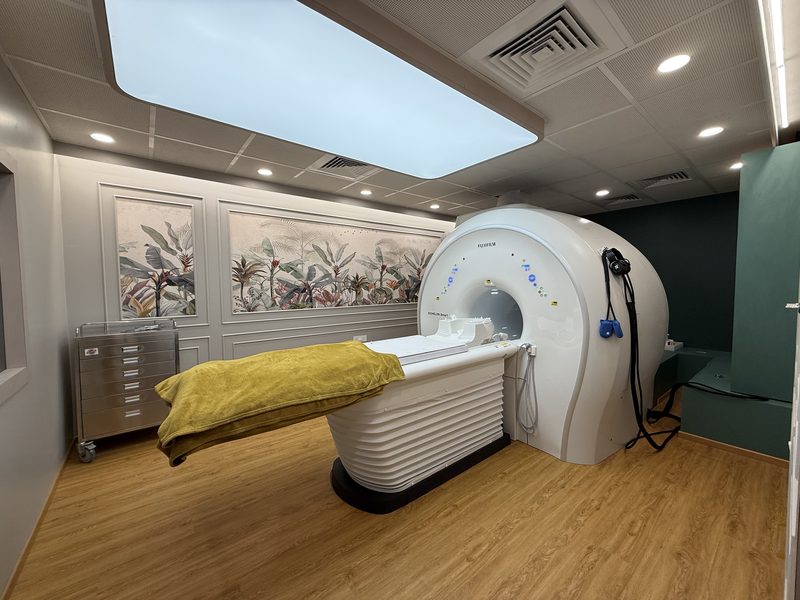
We scan on a Fujifilm ECHELON Smart MRI with a wide bore and music, and every MRI is reported by our panel of sub-specialty radiologists. Most scans of one body area take up to about 45 minutes in the scanner. Most reports the same day, sent to your WhatsApp.
At a glance
- Scanner
- Fujifilm ECHELON Smart MRI: a closed scanner with a wide bore, quieter scanning and in-scanner music
- Reported by
- our panel of sub-specialty radiologists
- Time in the scanner
- Up to about 45 minutes for most single-area scans; longer with contrast, more than one area, or a specialised scan such as cardiac MRI
- Preparation
- Most brain, spine and joint MRI: eat and drink as normal. MRCP: about 4 to 6 hours without food, water allowed. Other scans as advised when you book
- If you are anxious
- Wide bore and music, a team member who talks to you between sequences, and sedation under an anaesthesiologist if needed
- Report and images
- Most reports the same day, sent to your WhatsApp; images on a cloud link or DVD
- Hours
- Mon–Sat 8am–10pm, Sun 8am–5pm. Fetal MRI is not done on Sundays.
- Access
- Step-free ground floor
- Cost
- We tell you the exact figure on WhatsApp before you book.
Choose your scan
Head and blood vessels
- Brain MRI
Headache, seizures, dizziness or vertigo, memory problems, or follow-up after a stroke
- MRA / MR venography (brain)
When the arteries or veins of the brain need checking, often together with a brain MRI
Neck and back
- Cervical spine (neck) MRI
Neck pain with arm pain, numbness or tingling
- LS spine (lumbar) MRI
Low back pain with sciatica, the pain that runs down the leg
- Whole spine MRI
A screening of the neck, mid-back and lower back, usually added to a spine MRI when your doctor asks for it
Joints
- Knee MRI
A twisted knee that locks, swells or gives way: ligaments, meniscus and cartilage
- Shoulder MRI
Pain on lifting the arm, or a shoulder that slips out: rotator cuff and labrum, with MR arthrography when needed
- Ankle and foot MRI
An ankle sprain that has not settled, or Achilles or heel pain that has not improved
Abdomen and pelvis
- MRCP test
Stones in the bile duct, jaundice, or a widened duct seen on ultrasound
- MRI pelvis
Fibroids, adenomyosis, endometriosis, an ovarian cyst that ultrasound could not fully characterise, or a perianal fistula
- Prostate MRI (mpMRI)
A raised PSA blood test or an abnormal prostate examination; reported with a PI-RADS score
Heart, breast and pregnancy
- Cardiac MRI
Heart muscle problems such as cardiomyopathy or myocarditis, in adults and children
- Breast MRI
Breast implants, high-risk screening, planning after a breast cancer diagnosis, or a question left open after mammography and ultrasound
- Fetal MRI
A finding on the anomaly (TIFFA) scan that needs a closer look, usually from about 20 weeks, as your specialist advises. Fetal MRI is not done on Sundays.
The scanner and the room
Our MRI centre in Dadar West, near Siddhivinayak Temple and Shivaji Park, runs a Fujifilm ECHELON Smart MRI. The bore, the opening you lie in, is wide, which leaves room around your shoulders and face if you are broad-built or feel closed in. It is still a closed scanner: a lit tunnel, open at both ends.
The scanner is designed for quieter scanning, but every MRI knocks loudly while it takes pictures, so you always wear ear protection, and music can be played inside the scanner.
For complex studies, our radiologists use Fujifilm Synapse 3D to build 3D views from the images the scanner has already taken. It adds no time on the table.
How we plan and run your MRI
Your prescription decides the scan. Our radiologists plan each MRI around the question your doctor has asked, and we run fuller protocols, with more sequences, so that the report can answer that question.
Safety check
Before you go in, a team member goes through a metal and implant checklist with you.
Positioning
You lie on a padded table with a light receiver pad, called a coil, over the part being scanned. For knee, ankle and foot scans you lie with your feet towards the scanner, so your head usually stays near the opening or outside it.
The sequences
The scan is a series of sequences. You keep still, follow the breath-hold instructions for abdominal scans, and hold a call bell throughout. Between sequences the team tells you roughly how long the next part lasts.
Contrast, only if planned
If your scan needs contrast, it is given through a small cannula in an arm vein, usually partway through, and may feel briefly cool.
Who reads your MRI
Every MRI is reported by our panel of sub-specialty radiologists.
Comfort, safety and special situations
If closed spaces worry you
Tell us when you book, especially if you could not finish an MRI before, so the team can plan your scan. The wide bore, the music and a team member who keeps talking to you help many people through. Some find it easier to close their eyes before the table moves in. If you are still very anxious, sedation is available under an anaesthesiologist.
Sedation
Sedation is given by an anaesthesiologist. You will be told how long to fast before it. An adult must come with you and take you home, and you must not drive, ride or operate machinery for the rest of that day.
Metal and implants
The magnet is always on, so the safety checks are about metal. Before booking, tell us about any pacemaker or defibrillator, cochlear implant, aneurysm clip, nerve stimulator, insulin pump or glucose sensor, any metal fragment in an eye (for example from welding or grinding), or a medicine patch on your skin. Send the implant card or surgery papers on WhatsApp so the team can check before you travel. [1]
Pacemakers and implants
We scan only MR-conditional devices; non-conditional or older (legacy) devices are not scanned. Bring your implant card. A pacemaker is switched to MRI mode by the device company's representative, who attends, as arranged with your cardiologist.
Wheelchairs, walking frames and oxygen
Ordinary wheelchairs, walking frames and oxygen cylinders cannot go into the MRI room. If you use one, tell us when booking so your transfer can be planned. The entrance and scan rooms are on a step-free ground floor.
Contrast and pregnancy
Most brain, spine and joint MRIs need no injection. When gadolinium contrast is planned, a recent creatinine (kidney function) report may be requested, and the test can be done at the centre. If you are or could be pregnant, tell us before booking: gadolinium is generally avoided in pregnancy, and fetal MRI is done without it. [2]
Contrast and your medicines
Do not stop or change any medicine unless your doctor tells you to. Tell us about any earlier reaction to contrast, allergies, kidney disease or diabetes medicines, and if you are or may be pregnant. We check kidney function (creatinine can be done at the centre) and the radiologist decides about metformin. About 4 hours without food; water is allowed.
Please note
An MRI is a planned test. If you have sudden weakness or numbness of the face, arm or leg, difficulty speaking, sudden loss of vision, a sudden severe headache, or back pain with loss of bladder or bowel control or numbness around the back passage, go to a hospital emergency department instead of waiting for an MRI.
Food, clothing and what to leave outside the scanner room are covered in our MRI preparation guide.
Your MRI report and images
Most reports the same day, sent to your WhatsApp. Your images come on a cloud link (or a DVD on request) along with your report. Reports are sent only to the mobile number registered at your visit.
If there is an urgent finding, the radiologist contacts your doctor directly.
Some MRI reports follow a standard scoring system: prostate MRI is reported with PI-RADS v2.1, including the prostate volume and PSA density, and breast MRI with a BI-RADS category.
Bring your earlier reports and images of the same area, so the radiologist can compare them with the new scan.
How your MRI is quoted
The figure depends on the body part and how many regions are scanned, whether contrast is needed, and added sequences such as MR angiography or MRCP. We tell you the exact figure on WhatsApp before you book.
Each factor is explained, body part by body part, in our guide to MRI scan cost in Mumbai.
Frequently asked questions
Is there any radiation in an MRI scan?
No. MRI uses a strong magnet and radio waves, not X-rays. [1] The risks come from metal, some implants and, uncommonly, a reaction to a contrast injection, which is why the safety checklist comes before every scan.
Can I have an MRI on a Sunday?
Yes, many MRI scans can be done on a Sunday. Fetal MRI is not done on Sundays. We are open Monday to Saturday 8 am to 10 pm and Sunday 8 am to 5 pm. Send your prescription on WhatsApp (opens WhatsApp) and our team tells you whether your scan can be done on the day you want.
What should I bring to my MRI appointment?
Your prescription; earlier reports and images of the same area; your implant card or surgery papers, if you have an implant; a recent creatinine report if contrast is planned (the test can be done at the centre if you have none); and an adult to take you home if sedation is planned.
Can a family member stay with me in the scanner room?
Yes. A family member or caregiver may come with you, and anyone who stays in the scanner room goes through the same metal check as you.
How do I know which MRI my prescription is asking for?
Send a photo of it on WhatsApp (opens WhatsApp). Our radiologists read the request and tell you which scan it needs, whether contrast is planned and how to prepare.
Sources
- MRI Safety. RadiologyInfo.org (ACR, ASRT and RSNA).
- Contrast Materials. RadiologyInfo.org (RSNA, ACR and ASRT).
Related guides
Page updated
Book or ask a question
Visit us
AV Scan Diagnostics
Ground Floor, Shilpa Apartment, Shankar Ghanekar Marg, near Shivaji Park, Dadar West / Prabhadevi, Mumbai 400028
Dadar West / Prabhadevi, Mumbai, near Siddhivinayak Temple and Shivaji Park
Ground floor, step-free entrance
Landline 022-3522 0711
Opening hours
| Mon–Sat | 8:00 am – 10:00 pm |
|---|---|
| Sunday | 8:00 am – 5:00 pm |