At a Glance
| Also called | Follicular monitoring, folliculometry, follicle tracking, ovulation scan, TVS follicle study |
|---|
| Performed by | Our radiologists, Dr. Avinash Bansal and Dr. Vaishnavi Bansal (MD Radiology) |
|---|
| How it is done | Transvaginal (TVS); over the abdomen if you have never had intercourse |
|---|
| Radiation, injection or contrast | None |
|---|
| Preparation | Empty bladder, no fasting; our team confirms the exact preparation when you book on WhatsApp |
|---|
| First scan | Usually day 8-10 of a regular cycle, or as your doctor advises |
|---|
| Repeat scans | Every 1-3 days until signs of ovulation are seen |
|---|
| Time on the couch | Usually about 10-15 minutes per visit |
|---|
| Reports | Most reports the same day, sent to your WhatsApp |
|---|
| Price | Booked as a complete cycle; exact price confirmed on WhatsApp before your first visit |
|---|
| Insurance | Cashless with most major insurers/TPAs; CGHS, ECHS, MJPJAY. Cover for fertility-related scans varies |
|---|
What a follicle study shows
Each month, several small fluid-filled sacs (follicles) start to grow in the ovaries, and each one holds an immature egg. Usually one becomes dominant and releases its egg: this is ovulation. A follicle study (फॉलिकल स्टडी) follows this on ultrasound, visit by visit, recording:
- How many follicles are growing in each ovary, and the size of each in millimetres
- How fast the dominant (largest) follicle is growing, often about 1-2 mm a day in the days before ovulation
- The endometrium (lining of the womb): its thickness and pattern, often a layered 'triple-line' look before ovulation, becoming brighter and more uniform afterwards
- Signs that ovulation has happened: the follicle collapses, shrinks or disappears, a little fluid may appear behind the womb, and a corpus luteum (what the follicle becomes after releasing the egg) may be seen. Not every sign is seen every time
- On the first scan: any cyst left over from an earlier cycle, and any obvious fibroid or thickening of the lining that your doctor may want checked further
Follicle size and ovulation
In a natural cycle, a dominant follicle usually becomes distinguishable at about 10 mm, often around day 8-12, and ovulation usually happens once it reaches roughly 18-24 mm. These are typical figures only: they vary between women, between cycles and with fertility medicines. The scan measures; your gynaecologist or fertility specialist decides what the numbers mean for you, including when to plan intercourse, IUI or a trigger injection.
Sometimes a cycle does not go to plan: no follicle becomes dominant, a follicle reaches a good size but does not rupture and release its egg (a luteinised unruptured follicle), a follicle stays on as a cyst, or more follicles grow than your doctor wants. Repeat scans pick these up so your doctor can decide the next step.
When doctors request a follicle study
Your treating doctor decides the plan, including when to start, how often to scan and any medicines. Common reasons for the test include:
- Trying to conceive: to find out whether and when you ovulate, and to time intercourse to the fertile days
- Irregular periods or PCOS, where ovulation can be unpredictable
- Cycles with ovulation tablets (such as letrozole or clomiphene) or injections, to see how the ovaries respond
- Timing an IUI (intrauterine insemination) or a trigger injection
Do not wait for your next scan. Go to a hospital emergency department first, and inform your fertility doctor, if you have sudden severe pain low in the abdomen (especially on one side, with vomiting), heavy bleeding or fainting. Do the same if, during or in the days after fertility medicines or a trigger injection, your abdomen swells quickly or becomes very painful, or you have repeated vomiting, breathlessness or pass much less urine. These can be signs of a twisted ovary, bleeding from the ovary or ovarian hyperstimulation, which need urgent care. The same applies if you have a positive pregnancy test with pain low in the abdomen, shoulder-tip pain, bleeding or fainting.
When the scans start and how often
Count day 1 as the first day of proper bleeding, not spotting. In a regular cycle of about 28 days the first scan is often around day 8-10, and later with longer cycles. In a medicine cycle your doctor may ask for a baseline scan on day 2 or 3, before the tablets or injections start. Scans are then usually repeated every 1-3 days, more often as the follicle nears ovulation size, until signs of ovulation are seen or your doctor stops monitoring. After a trigger injection, your doctor may ask for a scan a day or two later to check that the follicle has ruptured.
If your period is late and your pregnancy test is positive, stop the follicle scans and ask your doctor when to have an early pregnancy scan.
How to prepare
Our team confirms the exact preparation when you book on WhatsApp. As a general guide:
- Empty your bladder just before a transvaginal scan; no fasting is needed
- A day 2-3 baseline scan is done during your period; bleeding does not stop the scan
- Note your cycle day 1, and any fertility tablet or injection with the day you started it
- Bring your doctor's prescription or treatment plan and any earlier follicle study or pelvic scan reports
- Wear a two-piece outfit, such as a kurta with trousers
- If you have never had intercourse, tell us when you book: the scan is then done over the abdomen with a full bladder
- Tell us if you have a latex allergy
What happens at each visit
You empty your bladder and lie on the couch with your knees bent. A slim probe with a fresh protective cover and gel is placed a short way into the vagina, close to the ovaries, so small follicles are seen clearly. Most women feel pressure rather than pain. The scan is done only with your consent and you can ask to stop at any time. If you would like a female staff member in the room, please tell us when you book.
A visit usually takes about 10-15 minutes on the couch, and you can go straight back to work. Ultrasound uses no radiation, and repeated diagnostic scans are not known to harm the follicles, the egg or your chances of conceiving.
What a follicle study cannot tell you
A follicle study tracks the ovaries and the lining through one cycle. It does not show:
- Whether the fallopian tubes are open: that needs a separate test, such as a sono-HSG with HyCoSy
- Egg quality, or the male partner's fertility, for which your doctor may ask for other tests
- Absolute proof of ovulation: the scan signs are strong evidence, and your doctor may also use a blood test
- Whether you will conceive: a normal follicle study cannot promise a pregnancy
- A full check for fibroids, polyps, ovarian cysts or PCOS: that is a separate pelvic ultrasound, usually early in the cycle, soon after a period
Your follicle study at AV Scan, Dadar West
To book a complete cycle, send a photo of your doctor's prescription and your cycle day 1 on WhatsApp +91 98200 51511, call the same number, or use our booking page.
- Performed by our radiologists, Dr. Avinash Bansal and Dr. Vaishnavi Bansal, both MD Radiology and FMF (UK) certified
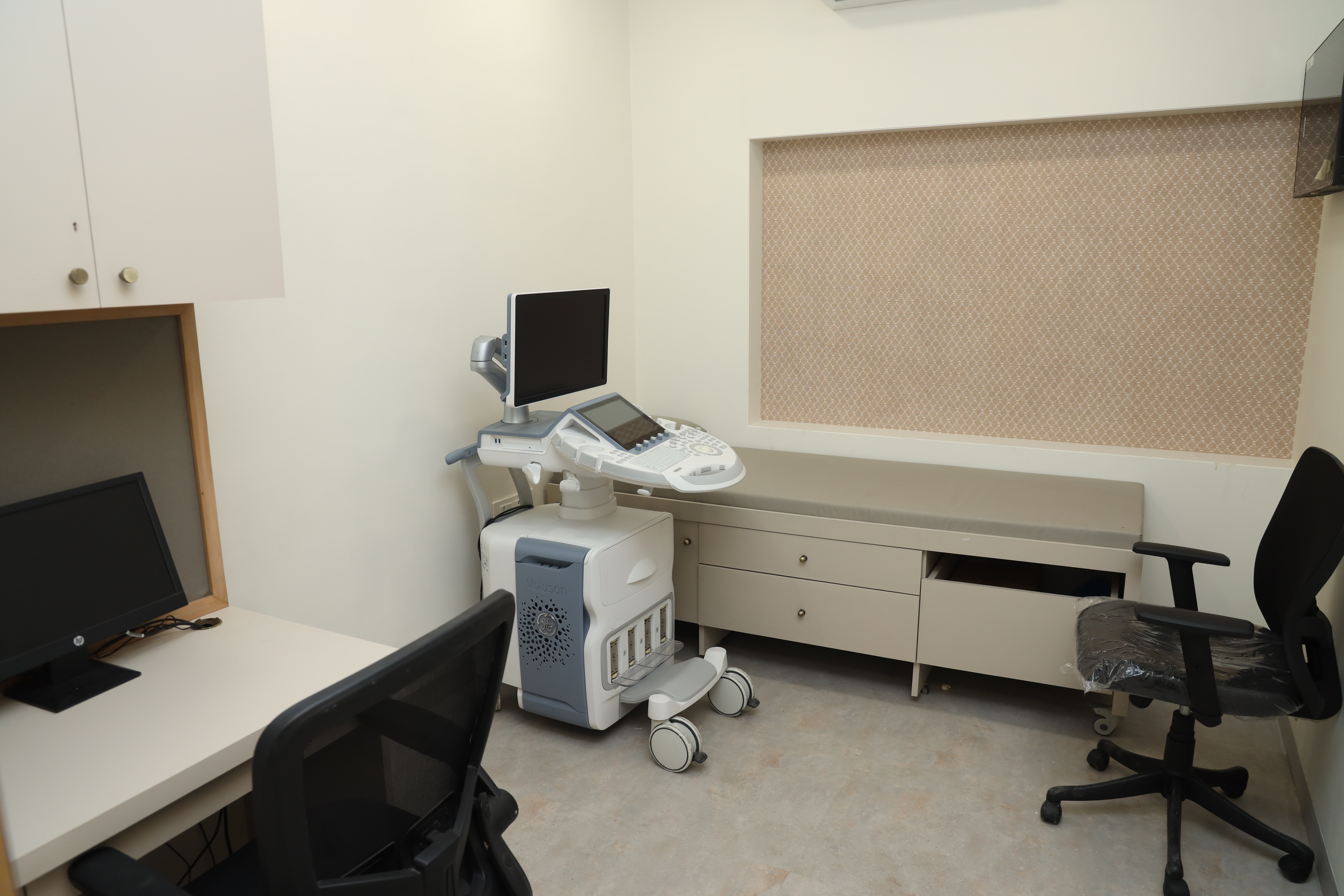
- Ultrasound systems: GE Voluson E10 and Philips Affiniti 70G
- Exact price for the complete cycle confirmed on WhatsApp before your first visit
- Most reports the same day, sent to your WhatsApp
- Cashless with most major insurers and TPAs; empanelled for CGHS, ECHS and MJPJAY (cover for fertility-related scans varies; our team checks what applies)
- Open Monday to Saturday 8am-10pm and Sunday 8am-5pm, so repeat visits are easier to fit around work
- Ground floor, step-free: Shilpa Apartment, Shankar Ghanekar Marg, Dadar West, Mumbai 400028, near Shivaji Park and Siddhivinayak Temple