At a Glance
| Also called | MRI prostate, multiparametric MRI (mpMRI), prostate mpMRI, PI-RADS MRI |
|---|
| Looks at | The prostate and seminal vesicles, plus the pelvic lymph nodes and bones in view |
|---|
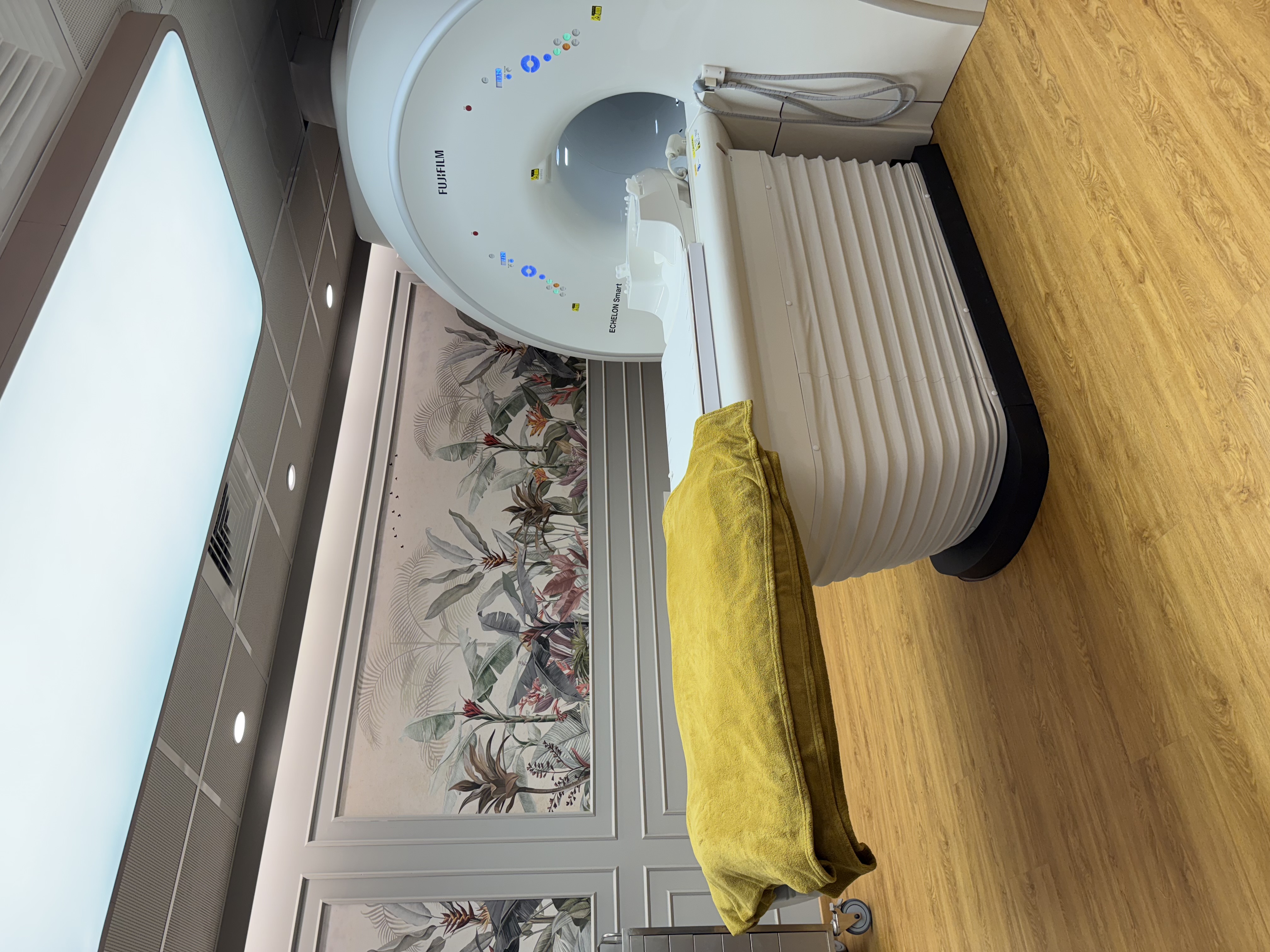
| Scanner | Fujifilm ECHELON Smart 1.5T MRI, quieter scanning, in-scanner music |
|---|
| Reported by | Our radiologists, Dr. Avinash Bansal and Dr. Vaishnavi Bansal (both MD Radiology) |
|---|
| Radiation | None (MRI uses a magnet and radio waves) |
|---|
| Contrast | Often a gadolinium injection into an arm vein; some scans are done without it. Creatinine can be tested at the centre if needed |
|---|
| Preparation | May include an empty bowel and no ejaculation for a few days; our team confirms the exact preparation when you book on WhatsApp |
|---|
| Time on the scanner | Usually about 30-45 minutes |
|---|
| Report | PI-RADS score for an untreated prostate; most reports the same day, sent to your WhatsApp |
|---|
| Price | Exact price confirmed on WhatsApp before your visit |
|---|
| Payment | Cashless with most major insurers and TPAs; empanelled for CGHS, ECHS and MJPJAY |
|---|
| Hours and access | Mon-Sat 8am-10pm, Sun 8am-5pm; ground floor, step-free |
|---|
What a prostate MRI (mpMRI) shows
Multiparametric means the scan combines three kinds of MRI picture:
- T2-weighted images: detailed anatomy of the prostate, its capsule and the seminal vesicles
- Diffusion-weighted imaging (DWI): shows how freely water moves in the tissue; tightly packed cancer cells restrict it, so a significant cancer often stands out
- Dynamic contrast-enhanced (DCE) images: taken as a contrast injection flows through the prostate; many cancers take it up early. A scan without this part is called a biparametric MRI, and is sometimes enough
The scan also shows the size of the prostate and the pelvic lymph nodes and bones in view. Patients also call it an MRI prostate (Hindi: प्रोस्टेट ग्रंथि का MRI). An enlarged prostate (BPH) is usually checked first with sonography (USG KUB, also done here), which measures the prostate's size and the urine left after passing urine but cannot reliably find or rule out cancer.
PI-RADS: what your score means
Prostate MRI is reported with PI-RADS (Prostate Imaging Reporting and Data System), an international 5-point scale of how likely an area is to be a clinically significant cancer, meaning one that may need treatment:
- PI-RADS 1: very low; a significant cancer is highly unlikely
- PI-RADS 2: low; a significant cancer is unlikely
- PI-RADS 3: intermediate; the finding is uncertain
- PI-RADS 4: high; a significant cancer is likely
- PI-RADS 5: very high; a significant cancer is highly likely
The score is a likelihood, not a diagnosis. Only a biopsy can confirm cancer and show its grade, and many PI-RADS 3 areas turn out not to be a significant cancer. Your urologist combines the score with your PSA, prostate size (PSA density), age, examination and family history to decide the next step.
PI-RADS is used for a prostate that has not been treated. After prostate surgery or radiotherapy, the report describes any suspicious area without a PI-RADS score.
When urologists request a prostate MRI
Urologists and oncologists usually request it for:
- A raised or rising PSA blood test, or a prostate that feels abnormal on examination
- Before a first biopsy, to help decide whether one is needed and where to aim the needles (a targeted or "fusion" biopsy)
- A negative biopsy with a PSA that keeps rising
- Active surveillance: watching a low-risk cancer with repeat MRI, PSA tests and biopsies as advised, instead of treating it straight away
- A newly diagnosed cancer, to see whether it reaches beyond the prostate, into the seminal vesicles or nearby lymph nodes, before surgery or radiotherapy is planned
- A rising PSA after prostate surgery or radiotherapy, to look for disease in the prostate area; a PSMA PET-CT is often advised as well
If no suspicious area is seen, your urologist may decide, with your PSA and other factors, that an immediate biopsy is not needed. If a biopsy is being considered, have the MRI first where possible, because bleeding after a biopsy can blur the pictures for several weeks.
How to prepare for a prostate MRI
Our team confirms the exact preparation when you book on WhatsApp. As a general guide, you may be advised to:
- Empty your bowel, sometimes with a small enema; gas and stool in the rectum, just behind the prostate, can distort the pictures
- Avoid ejaculation for about 3 days, which may help show the seminal vesicles more clearly
- Not eat for a few hours, to reduce bowel movement; water and regular medicines are usually fine. If you take insulin or diabetes tablets, tell us so fasting is planned safely
- Bring your PSA reports, any previous prostate MRI, biopsy reports, and operation or radiotherapy notes
Tell us before booking about any pacemaker or defibrillator, cochlear implant, aneurysm clip, nerve stimulator, metal in the eye, heart valve, penile implant or artificial urinary sphincter, and bring the device card. Some pacemakers and MR-conditional implants can be scanned here under supervision, following the device's MRI conditions; others cannot be scanned. Also tell us about a hip replacement or metal seeds or markers from earlier prostate treatment: these are usually safe in the scanner but can blur the prostate pictures, so the scan may need to be adapted. See our MRI preparation guide.
A bowel-relaxing (antispasmodic) injection is sometimes given to keep the pictures sharp. Tell us if you have glaucoma, a heart condition, myasthenia gravis or difficulty passing urine, as it may not be suitable.
What happens during the scan
After a metal-safety checklist, you change into a gown and lie on your back with a light, padded coil over your pelvis; if contrast is planned, a small cannula goes into an arm vein. You get ear protection, and the ECHELON Smart offers quieter scanning and in-scanner music. You hold a call bell and lie still for usually about 30-45 minutes. If closed spaces make you anxious, tell us when you book; if needed, sedation is available under the supervision of an anaesthesiologist.
Afterwards you can carry on normally. The bowel-relaxing injection can blur vision briefly, so do not drive until it is clear; if you get a painful, red eye or cannot pass urine in the hours afterwards, get urgent medical help.
Contrast and safety
MRI uses a magnet and radio waves, so there is no radiation. The contrast is a gadolinium-based dye, not the iodine dye used for CT; reactions are uncommon and usually mild, and serious reactions are rare.
A recent kidney function (serum creatinine) report may be requested; if you do not have one, the test can be done here at the centre before the scan. Tell us about any allergy or previous contrast reaction, asthma, kidney disease or dialysis, and diabetes, including whether you take metformin. Metformin does not usually need to be stopped for MRI contrast; we check your kidney function and advise you, so please tell us about all your medicines. If contrast is not suitable for you, the radiologist can discuss a scan without it (biparametric MRI) with your urologist.
Go to a hospital emergency department first if you cannot pass urine at all, have fever with shivering and burning urine (especially after a recent biopsy), or are passing heavy blood or clots in your urine. These need urgent treatment, not an outpatient scan.
What a prostate MRI cannot tell you
Prostate MRI guides decisions, but it has limits:
- A low score does not always mean no cancer. Some significant cancers are not visible on MRI, so follow-up PSA tests or a biopsy may still be advised
- It cannot give the grade (Gleason score) of a cancer; only a biopsy can
- Inflammation (prostatitis), benign enlargement and bleeding after a biopsy can look like cancer, or hide it
- Lymph nodes are judged mainly by their size and shape, so a small node containing cancer can look normal
- It covers the pelvis only. If cancer is diagnosed, tests such as a PSMA PET-CT or a bone scan may be requested for the rest of the body
Your prostate MRI at AV Scan, Dadar West
WhatsApp +91 98200 51511 with a photo of your prescription and most recent PSA report, call the same number, or use our booking page. What to expect:
- Reported by our radiologists, Dr. Avinash Bansal and Dr. Vaishnavi Bansal (both MD Radiology), who compare your scan with any earlier MRI you bring
- Fujifilm ECHELON Smart 1.5T MRI, with quieter scanning and in-scanner music
- The exact price is confirmed on WhatsApp before your visit; cashless with most major insurers and TPAs, and empanelled for CGHS, ECHS and MJPJAY
- Most reports the same day, sent to your WhatsApp; ask for the images too if a targeted biopsy is planned
- Open Monday to Saturday 8am-10pm and Sunday 8am-5pm
- Ground floor, step-free: Shilpa Apartment, Shankar Ghanekar Marg, Dadar West, Mumbai 400028, near Shivaji Park and Siddhivinayak Temple
For the hips, bladder or a perianal fistula, see MRI pelvis, or all MRI scans in Dadar West.