At a Glance
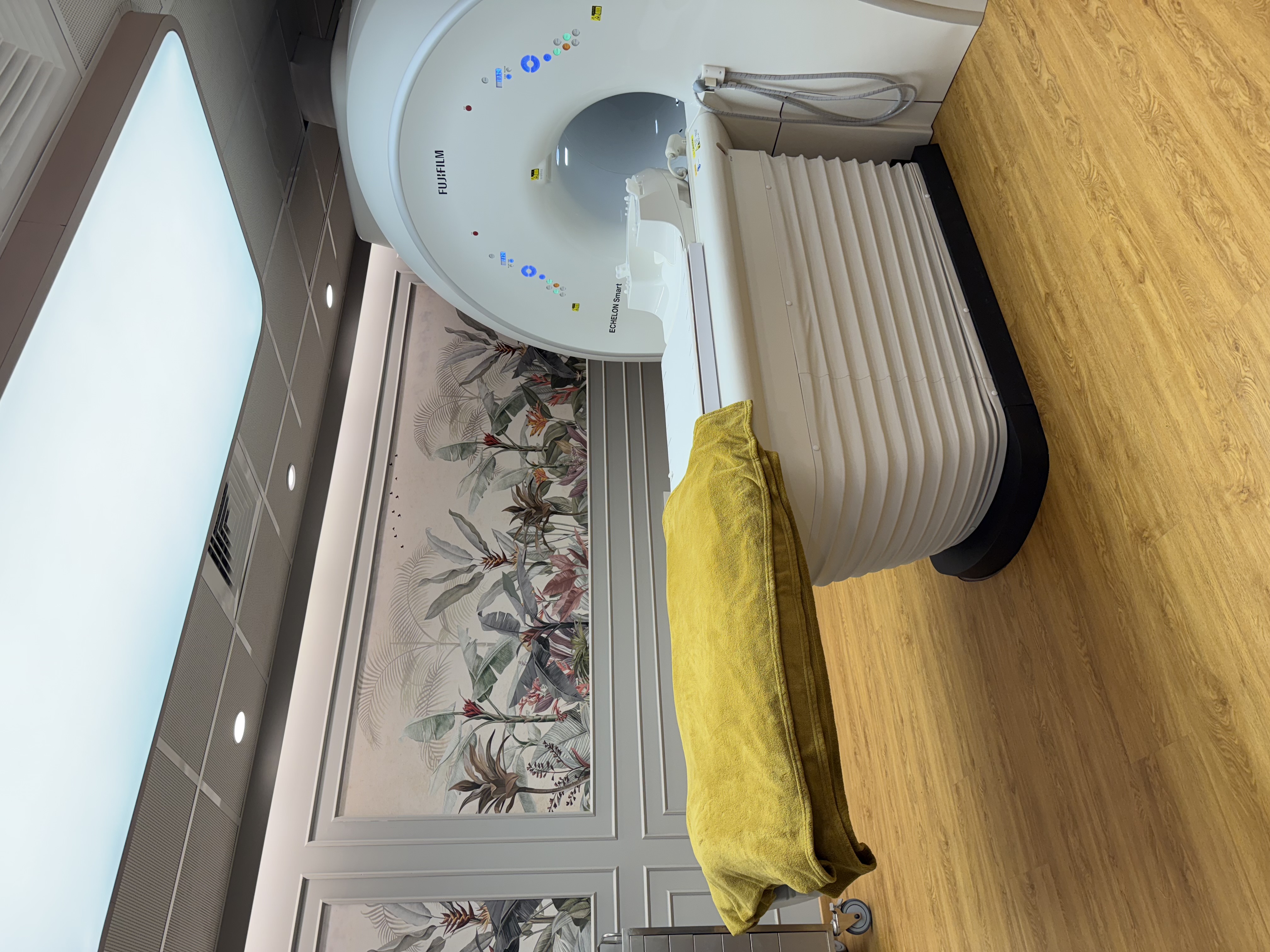
| Scanner | Fujifilm ECHELON Smart 1.5T MRI |
|---|
| Reported by | Dr. Avinash Bansal, MD Radiology |
|---|
| Time on the table | Usually about 20-45 minutes, depending on the question |
|---|
| Radiation | None |
|---|
| Preparation | Varies; confirmed when you book on WhatsApp |
|---|
| Contrast | Only if your doctor's question needs it |
|---|
| Report | Most reports the same day, sent to your WhatsApp |
|---|
| Price | Confirmed on WhatsApp before your visit |
|---|
| Insurance | Cashless with most major insurers/TPAs; CGHS, ECHS, MJPJAY |
|---|
| Open | Mon-Sat 8am-10pm, Sun 8am-5pm |
|---|
What an MRI pelvis shows
MRI shows soft tissue in fine detail without X-rays.
In Hindi, fibroids are often described as बच्चेदानी में गांठ, and a perianal fistula as भगंदर (bhagandar).
An MRI pelvis can show:
- Fibroids: how many, how large, and where each one sits (in the cavity, within the wall, or on the outer surface), which helps your gynaecologist plan treatment.
- Adenomyosis: lining tissue of the uterus growing into its muscle wall, seen on MRI as thickening of the inner muscle layer (the junctional zone). MRI helps tell it apart from fibroids when ultrasound is unclear.
- Endometriosis: endometriomas ("chocolate cysts") and deep nodules behind the uterus or near the bowel and bladder. Very small, superficial patches may not show on any scan, so a normal MRI does not always rule endometriosis out.
- Ovarian cysts and masses that sonography could not fully explain; MRI can show whether a cyst contains fluid, blood, fat or solid tissue.
- Uterine shape differences present from birth, such as a septate or bicornuate uterus.
- Hips, sacroiliac (SI) joints and pelvic bones: early avascular necrosis (AVN) of the hip, stress fractures, sacroiliitis, and muscle or tendon injuries around the hip and groin. Some hip questions, such as a suspected labral tear, may need a different, dedicated hip scan; your doctor's prescription decides which.
- Perianal fistula and abscess (MRI fistulogram), and swellings in the perineum.
- Bladder, pelvic lymph nodes and other pelvic lumps.
When doctors request an MRI pelvis
MRI usually comes after a pelvic ultrasound (USG pelvis), not instead of it, when ultrasound cannot fully answer the question or a surgeon needs a detailed map. If your doctor needs the abdomen as well, an MRI abdomen and pelvis covers both in one visit. Common reasons for an MRI pelvis:
- Fibroids on sonography, before a myomectomy or other treatment
- Heavy or painful periods where adenomyosis is suspected
- Painful periods, pain during intercourse or on passing stools, or difficulty conceiving, with suspected endometriosis
- An ovarian cyst or mass that needs characterising
- Hip, groin or buttock pain with a normal X-ray
- A boil near the anus that keeps discharging, or a fistula that has come back after surgery
- Follow-up of a known pelvic condition
How to prepare for an MRI pelvis
Preparation depends on the question your doctor is asking, so our team confirms the exact preparation when you book on WhatsApp. As a general guide:
- Food: for scans of the uterus and ovaries, or when contrast may be given, you may be asked not to eat for about 4-6 hours; this reduces bowel movement that can blur the pictures. Sips of water and regular medicines are usually fine. If you have diabetes and take insulin or sugar-lowering tablets, ask us how to manage food and medicines on the day so your sugar does not drop too low.
- Bladder: some scans need a moderately full bladder, not an uncomfortably full one.
- Bowel-relaxing injection: for some women's pelvic scans, a small injection may be given to briefly slow the bowel and keep the pictures sharp. Tell us if you have glaucoma, a heart condition or fast heart rhythm, myasthenia gravis, or difficulty passing urine, as the injection may not be suitable.
- Metal and implants: tell us before booking about a pacemaker or defibrillator, cochlear implant, brain aneurysm clip, nerve stimulator, insulin pump, metal fragments in the eye, any heart valve or other surgical implant, or metal implants such as a hip replacement. Medicine skin patches may need to be removed, so mention them too.
- Wear loose clothes; you will change into a gown and remove jewellery, hairpins, watches and cards.
- If you get anxious in closed spaces, tell us when you book so our team can plan and talk you through the scan.
- Bring your prescription, previous scan reports and images, and any operation notes.
Tell our team before booking if you are, or might be, pregnant, or if you are breastfeeding.
What happens during the scan
After a short metal-safety checklist, you lie on your back and a light, padded coil is placed over your lower abdomen and hips. If contrast is planned, a small cannula goes into an arm vein.
The scanner makes knocking sounds; you get ear protection, and our Fujifilm ECHELON Smart offers quieter scanning and in-scanner music. You hold a call bell throughout, and your only job is to keep still.
Afterwards you can carry on normally. If you had the bowel-relaxing injection, your vision may blur and your mouth may feel dry for a short while, so please do not drive until your vision is clear. If you develop a painful, red eye with blurred vision in the hours afterwards, get urgent medical help straight away.
Contrast and safety
Many pelvic MRIs need no contrast. Contrast (a gadolinium-based dye) may be used to characterise an ovarian mass, look for an abscess or active inflammation around a fistula, or assess some tumours; the radiologist decides based on your doctor's question. Reactions to MRI contrast are uncommon and usually mild, and our team is prepared to manage them.
If contrast may be needed, a recent kidney function (serum creatinine) report may be requested; blood for it can be given at the centre. Tell us about any allergy or previous contrast reaction, asthma, kidney disease, and diabetes, including whether you take metformin.
In pregnancy, MRI is done only when your doctor feels it is needed, and contrast is generally avoided. A hip replacement or pelvic plates may still allow a scan, but metal blurs nearby pictures, so we check first.
Go to a hospital emergency department first if you have sudden severe pain in the lower abdomen or pelvis (especially if you could be pregnant), heavy bleeding, fainting, fever with a painful swelling near the anus, or you cannot stand or walk after a fall onto the hip. An outpatient MRI is not the right first step.
MRI fistulogram and MRI perineum
A perianal fistula (fistula-in-ano) is a small tunnel between the anal canal and the nearby skin, usually left after an abscess. An MRI fistulogram shows the track's course, how it relates to the sphincter muscles that control the bowel, and any side branches or hidden abscess. Surgeons use this map to plan the operation, particularly when a fistula has come back or is linked to Crohn's disease.
Usually nothing is inserted into the fistula opening, and contrast is sometimes given; our team confirms the preparation when you book. An MRI perineum looks at swellings, abscesses or pain in the area around the genitals and anus.
Your MRI pelvis at AV Scan
To book, WhatsApp +91 98200 51511 with a photo of your prescription, call the same number, or use our booking page. What to expect:
- Reported by Dr. Avinash Bansal, MD Radiology (MRI, CT, musculoskeletal and interventional radiology), who reads your images alongside any earlier scans you bring.
- Fujifilm ECHELON Smart 1.5T MRI, with quieter scanning and in-scanner music.
- Pelvic sonography, which often comes first, is done here too; Dr. Vaishnavi Bansal, MD Radiology, looks after breast, women's and fetal imaging.
- The exact price is confirmed on WhatsApp before your visit. Cashless with most major insurers and TPAs; empanelled for CGHS, ECHS and MJPJAY.
- Open Monday to Saturday 8am-10pm and Sunday 8am-5pm; most reports the same day, sent to your WhatsApp.
- Ground floor, step-free: Shilpa Apartment, Shankar Ghanekar Marg, Dadar West, Mumbai 400028, near Shivaji Park and Siddhivinayak Temple.