At a Glance
| Also called | CT PNS, HRCT PNS, sinus CT, CT paranasal sinuses, PNS axial and coronal |
|---|
| What it covers | The sinuses, the nasal cavity, septum and the bone around them |
|---|
| Contrast | Not needed for most scans; contrast (CECT PNS) only in specific cases |
|---|
| Preparation | Usually none for a plain scan; our team confirms when you book on WhatsApp |
|---|
| Time | Scanning usually takes less than a minute; usually about 10-15 minutes in the room |
|---|
| Reported by | Dr. Avinash Bansal, MD (Radiology) |
|---|
| Report | Most reports the same day, sent to your WhatsApp |
|---|
| Price | Exact price confirmed on WhatsApp before your visit |
|---|
| Open | Mon-Sat 8am-10pm, Sun 8am-5pm |
|---|
What a CT PNS shows
The paranasal sinuses (PNS) are air spaces in the face bones: in the cheeks (maxillary), above the eyebrows (frontal), between the eyes (ethmoid) and deep behind the nose (sphenoid). They drain into the nose through narrow channels. When swollen lining, polyps or the shape of the nose block those channels, mucus collects and infection can keep coming back.
A sinus CT shows the air spaces and the thin bone around them in far more detail than an X-ray. In Hindi and Marathi it is usually just called "sinus" (साइनस / सायनस).
- Thickened sinus lining, fluid and blocked sinuses in chronic or repeated sinusitis
- Narrowing or blockage of the main shared drainage pathway (the ostiomeatal unit)
- Nasal polyps and how far they extend
- A deviated nasal septum, bony spurs and enlarged turbinates
- Anatomical variations a surgeon needs to know about, such as an air-filled middle turbinate (concha bullosa)
- The thin bony walls next to the eye socket and the base of the skull
- Features that can suggest fungal sinusitis or a growth, which may then need further tests
When doctors ask for a sinus CT
A single, short-lived sinus infection is usually treated without any scan. CT is requested when symptoms last or keep returning, when a complication or a growth is suspected, or before surgery.
The CT is read together with your symptoms and your ENT doctor's endoscopy findings. Mild thickening of the sinus lining is common in people with no sinus problem, and headache or facial pain on its own is often not caused by the sinuses, so a sinus CT can be normal even when you feel unwell.
- Blocked nose, facial pressure, thick discharge or post-nasal drip lasting 12 weeks or more despite treatment (chronic rhinosinusitis)
- Sinus infections that come back several times a year
- Before FESS (functional endoscopic sinus surgery), where the CT is the surgeon's map of your anatomy, and sometimes before nose surgery such as septoplasty
- Nasal polyps seen on endoscopy, or a reduced sense of smell along with other nasal symptoms
- One-sided blockage, one-sided or blood-stained discharge; your doctor may then ask for a contrast CT or an MRI
- Symptoms that return after earlier sinus surgery
Go to a hospital emergency department first, not a scan centre, if sinus symptoms come with swelling, redness or pain around the eye, a bulging eye or painful eye movements, blurred or double vision, a severe headache with high fever, a stiff neck, confusion or drowsiness. The same applies if you have diabetes, take steroids or have low immunity and notice facial swelling or numbness, or black crusts or blackish discharge from the nose. These can mean a serious infection is spreading and needs treatment the same day.
How to prepare
For a plain CT PNS there is usually no preparation. You can eat, drink and take your regular medicines as normal. Our team confirms the exact preparation when you book on WhatsApp.
- Bring your prescription and any earlier sinus CT, X-ray or endoscopy reports.
- Remove earrings, nose pins, hairpins, spectacles and hearing aids; removable dentures with metal parts may need to come out too.
- Metal fillings, braces, dental implants and pacemakers do not stop you having a CT. Do mention them, as dental metal can cause streaks on the images.
- If you are or could be pregnant, tell us before any CT or X-ray.
- For a contrast scan (CECT PNS), you may be asked not to eat for a few hours beforehand, and a recent kidney function (serum creatinine) report may be requested.
- Before a contrast scan, tell us about any allergies (especially an earlier reaction to contrast dye), asthma, kidney disease, an overactive thyroid or planned radioactive iodine treatment, and diabetes medicines such as metformin. Do not stop any medicine on your own; we will tell you if anything needs to be paused.
What happens during the scan
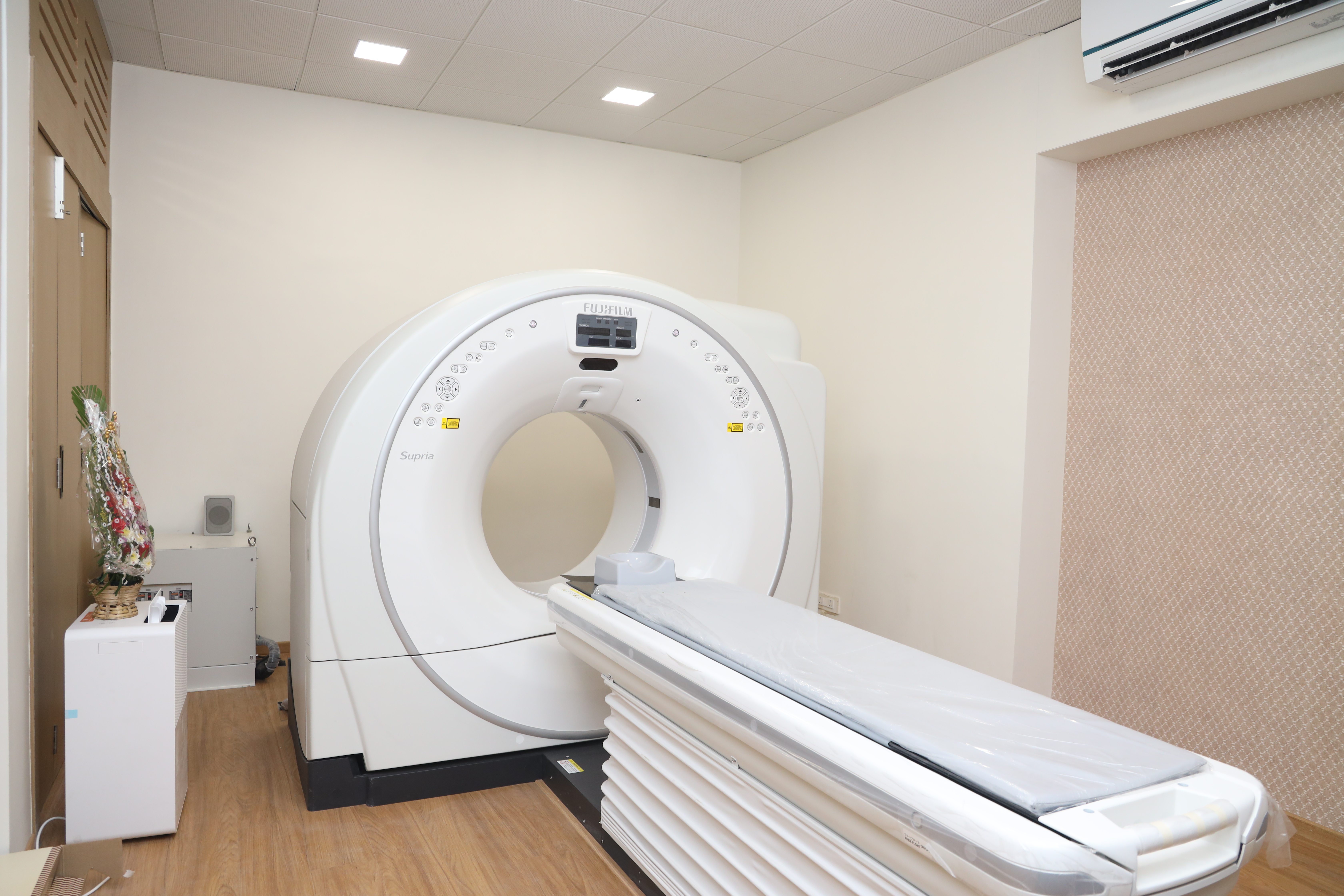
You lie on your back with your head resting in a support. The scanner is a short, wide ring rather than a long tunnel, and only your head goes inside it. You keep still while the table moves; the scanning itself usually takes less than a minute.
For a plain scan you are usually in and out of the room in about 10-15 minutes. If contrast is needed, it is given through a small cannula in an arm vein during the scan; most people feel only a brief warm flush or a metallic taste. We check you are well for a short while afterwards before removing the cannula, and you can then return to your normal day.
Is it safe? Radiation and contrast
CT uses X-rays. A sinus CT is among the lower-dose CT examinations, and the settings are chosen to use no more radiation than the clinical question needs, with care for the eyes, which lie in the scan area. When there is a clear medical reason, the benefit of the scan is generally considered to outweigh the small radiation risk. If you are or could be pregnant, tell us first; your doctor and the radiologist will decide whether the scan should go ahead or wait.
Contrast (CECT PNS) is added only in specific situations: suspected spread of infection towards the eye or brain, a suspected growth, or when your ENT doctor asks for it. Most people tolerate iodinated contrast well; itching or a rash is uncommon and serious reactions are rare. A seafood or shellfish allergy does not by itself mean you will react to contrast, but do mention any allergy. If you are breastfeeding, you can usually continue as normal.
Your sinus CT at AV Scan
Your scan is read and signed by a named radiologist, and the practical details are settled on WhatsApp before you leave home.
- Reported by Dr. Avinash Bansal, MD (Radiology). The report describes each sinus, the drainage pathways and the anatomical points ENT surgeons check before FESS.
- Scanned on our multi-slice CT, with the coronal and sagittal views built from one thin-slice scan.
- Most reports the same day, sent to your WhatsApp.
- The exact price is confirmed on WhatsApp before your visit. Send us a photo of your prescription.
- Cashless with most major insurers and TPAs, and empanelled for CGHS, ECHS and MJPJAY. Tell us your insurer or scheme when you book.
- Open Monday to Saturday 8am-10pm and Sunday 8am-5pm.
- Ground floor with step-free entry, on Shankar Ghanekar Marg near Shivaji Park and Siddhivinayak Temple.
Other ENT scans we do
On a doctor's prescription we also do HRCT temporal bone (a thin-slice CT of the ear bones, for long-standing ear discharge, suspected cholesteatoma, some types of hearing loss or planning before ear surgery), CT of the facial bones, CT of the neck and X-ray PNS. After a fresh injury to the face, especially with heavy bleeding, a change in vision or any loss of consciousness, go to a hospital emergency department first.