At a Glance
| Also called | MRI MRCP, bile duct MRI, magnetic resonance cholangiopancreatography |
|---|
| Looks at | Bile ducts, gallbladder and pancreatic duct |
|---|
| Radiation | None (MRI uses a magnet and radio waves) |
|---|
| Injection | Usually not needed; contrast may be added when the liver or pancreas also needs to be assessed |
|---|
| Preparation | Usually fasting for about 4–6 hours; our team confirms the exact preparation when you book on WhatsApp |
|---|
| Time on the scanner | Usually about 20–30 minutes; longer if contrast is added |
|---|
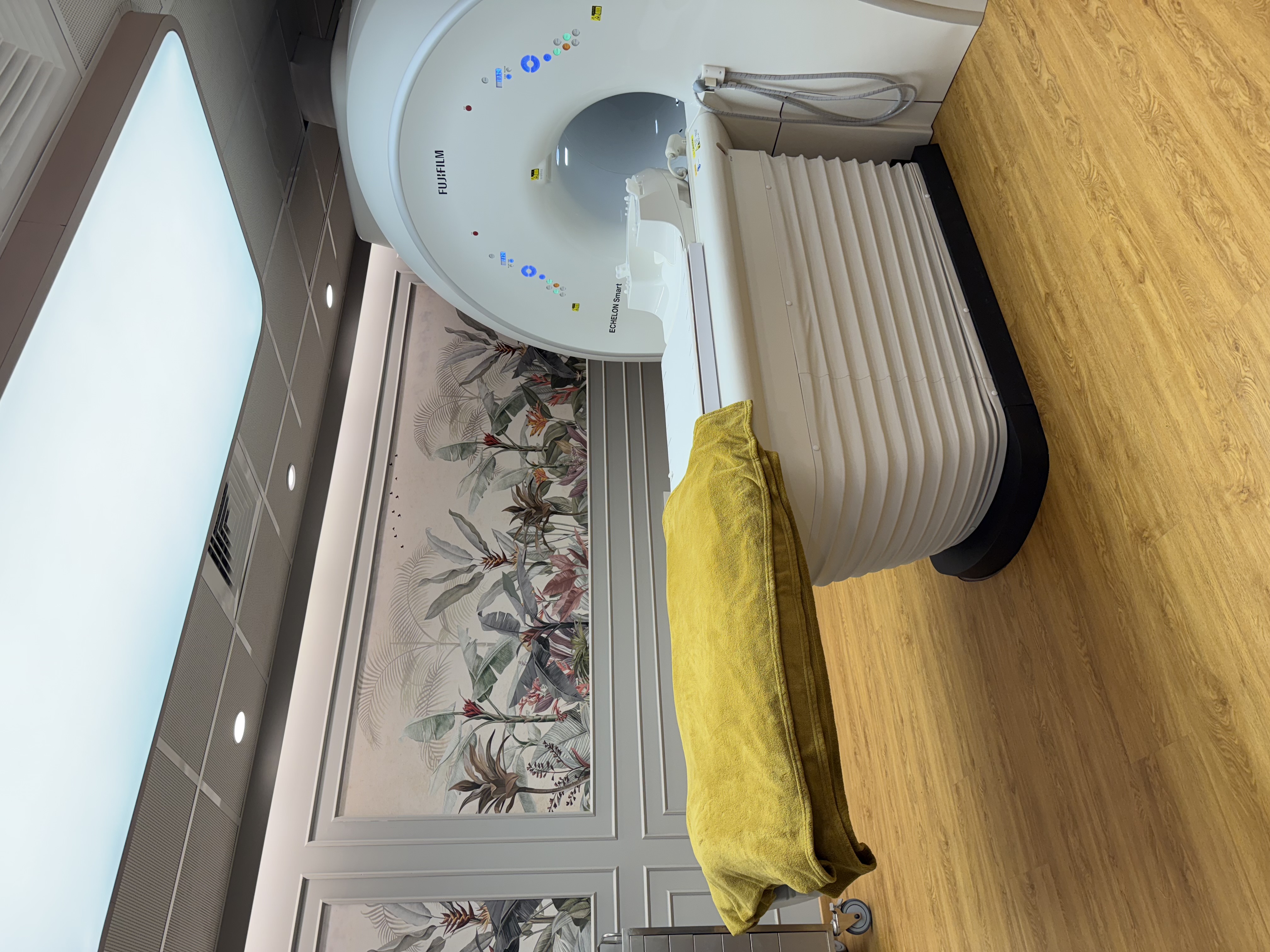
| Scanner | Fujifilm ECHELON Smart 1.5T MRI, quieter scanning, in-scanner music |
|---|
| Reported by | Dr. Avinash Bansal, MD (Radiology) |
|---|
| Report | Most reports the same day, sent to your WhatsApp |
|---|
| Price | Exact price confirmed on WhatsApp before your visit |
|---|
| Payment | Cashless with most major insurers and TPAs; empanelled for CGHS, ECHS and MJPJAY |
|---|
| Hours and access | Mon–Sat 8am–10pm, Sun 8am–5pm; ground floor, step-free |
|---|
What an MRCP scan shows
MRCP is a set of MRI pictures that make still fluid, such as bile, look bright. The bile ducts and the pancreatic duct then stand out clearly, and the scanner builds thin slices and 3D views of them. It is also called an "MRI MRCP" or a "bile duct MRI" (Hindi: पित्त नली और अग्न्याशय का MRI).
It is used to look for:
- Stones in the common bile duct (CBD stones) and in the gallbladder
- Widening (dilatation) or narrowing (stricture) of the bile ducts, and the level of any blockage
- Pancreatic duct changes from chronic pancreatitis, and duct variations such as pancreas divisum
- Pancreatic cysts, including follow-up of a cyst seen on an earlier scan
- Choledochal cysts and inflammatory duct conditions such as primary sclerosing cholangitis (PSC)
- The anatomy of the ducts after earlier surgery on the bile ducts or pancreas
- A growth narrowing the ducts; this usually also needs a contrast MRI or a contrast CT
When doctors ask for an MRCP
Your gastroenterologist, surgeon or physician usually requests an MRCP when an earlier test raises a question about the ducts. Common reasons include:
- Jaundice (yellow eyes or skin), dark urine or pale stools
- Liver function tests showing raised bilirubin, ALP or GGT
- A sonography (USG) report of a widened common bile duct or a possible duct stone
- Gallstones with pain or abnormal liver tests, to check the bile duct for stones before gallbladder surgery
- Pancreatitis, especially if it recurs or the cause is unclear
- Pain or abnormal liver tests after gallbladder removal
If you have severe upper abdominal pain (for example spreading to the back), fever with shivering and yellow eyes, repeated vomiting, or you feel drowsy or confused, go to a hospital emergency department first. These can be signs of an infected, blocked bile duct (cholangitis) or acute pancreatitis, which need urgent hospital treatment, not an outpatient scan.
MRCP vs ERCP, and where ultrasound and CT fit
MRCP is a scan: no tube or endoscope is passed into your body, sedation is usually not needed and there is no radiation. It diagnoses; it cannot remove a stone or open a blocked duct.
ERCP (endoscopic retrograde cholangiopancreatography) is a hospital procedure done by a gastroenterologist, usually under sedation. A flexible tube is passed through the mouth into the intestine, dye is injected into the ducts and X-rays are taken. It is used mainly for treatment, such as removing stones or placing a stent, and carries a small risk of complications such as pancreatitis, bleeding, infection or, rarely, a tear (perforation). This is why doctors often ask for an MRCP first.
Abdominal ultrasound (sonography) is usually the first test for gallbladder problems, but bowel gas can hide the lower end of the bile duct; MRCP shows the full length of the ducts. A contrast CT of the abdomen (CECT) is often used for complications of pancreatitis and for masses, but can miss bile duct stones that look similar to bile. For very small stones or lesions near the lower end of the duct, your doctor may suggest an endoscopic ultrasound (EUS), which is a hospital procedure.
How to prepare for an MRCP
Standard preparation is below. Our team confirms the exact preparation for you when you book on WhatsApp.
- Fasting: you will usually be asked not to eat or drink for about 4–6 hours beforehand. An empty stomach keeps fluid in the stomach and intestine from overlapping the ducts, reduces bowel movement and keeps the gallbladder full, so it is seen clearly.
- Regular medicines: take them as usual with a small sip of water, unless your doctor has advised otherwise.
- Diabetes: tell us when you book if you take insulin or tablets for diabetes, so the appointment time and fasting can be planned safely. Ask your own doctor how to adjust your diabetes medicines on the day, so that your sugar does not drop too low.
- Bring your prescription and previous reports (ultrasound, CT, liver function tests, any ERCP, stent or surgery notes).
- Wear loose clothing without metal and leave jewellery at home; you may be asked to change into a gown.
What happens during the scan
You lie on your back with a light receiver pad (coil) over your upper abdomen. For some pictures you hold your breath for several seconds at a time; for others you breathe gently and evenly. Following these instructions closely keeps the pictures of the ducts sharp, because breathing movement blurs them.
The scanner makes knocking sounds while it works; the ECHELON Smart is designed for quieter scanning, and you can listen to music. The team can hear you and talk to you throughout, and you hold a call button you can press at any time. An MRCP alone usually takes about 20–30 minutes on the scanner, longer if contrast is added. Afterwards you can usually eat, drink and carry on as normal; the team will tell you if anything different applies to you.
MRI safety checks
MRCP uses a strong magnet and radio waves, not X-rays, so there is no radiation. Because the magnet is always on, tell us before booking if you have:
- A pacemaker, implanted defibrillator (ICD), cochlear implant, nerve or spinal cord stimulator
- Brain aneurysm clips, a programmable shunt, or metal fragments in the eye or body (for example from welding or grinding work, or an old injury)
- An insulin pump, glucose sensor or medicine patch on the skin; these usually need to be removed before the scan
- A bile duct or pancreatic stent: plastic stents are not a safety problem, and most metal stents are safe under set conditions, but a metal stent can blur the part of the duct around it, so tell us which type you have
- A joint replacement, heart valve, heart or blood vessel stent or other implant; many are safe for MRI under set conditions, so bring the implant card or surgery papers
Please do not come for any MRI without first telling us about a pacemaker, defibrillator, cochlear implant, nerve stimulator or metal in the eye. Some of these devices can be scanned only under specific conditions, and some cannot be scanned at all.
Contrast, pregnancy and anxiety in the scanner
MRCP itself does not need an injection. If your doctor also wants the liver or pancreas assessed, for example for a cyst, an unexplained narrowing or a possible growth, a gadolinium contrast injection into an arm vein may be added; this is different from the iodine dye used for CT. A recent kidney function (serum creatinine) report may be requested, especially if you have kidney disease, diabetes, high blood pressure or are older; if you do not have one, blood for a creatinine test can be collected at the centre. Tell us about any allergy, any previous reaction to contrast, kidney disease or dialysis, and diabetes medicines such as metformin.
If you are or might be pregnant, tell us before the scan. MRCP without contrast can be done in pregnancy when your doctor feels it is needed; gadolinium contrast is generally avoided in pregnancy unless it is essential. If you are breastfeeding, tell us too; current guidance is that breastfeeding usually does not need to stop after a gadolinium injection, and the team can discuss this with you.
If closed spaces make you anxious, tell us when you book. Quieter scanning, music and a team that talks you through each step can make the scan easier.
Your MRCP at AV Scan, Dadar West
Share your prescription on WhatsApp and our team will confirm the preparation, whether contrast is likely, and the exact price before your visit.
- Reported by Dr. Avinash Bansal, MD (Radiology), who reports MRI and CT at AV Scan
- Scanned on a Fujifilm ECHELON Smart 1.5T MRI, with quieter scanning and in-scanner music
- Cashless with most major insurers and TPAs; empanelled for CGHS, ECHS and MJPJAY
- Report: most reports the same day, sent to your WhatsApp
- Open Monday to Saturday 8am–10pm and Sunday 8am–5pm
- Ground floor with step-free entry: Shilpa Apartment, Shankar Ghanekar Marg, Dadar West / Prabhadevi, near Shivaji Park and Siddhivinayak Temple