At a Glance
| Also called | Head CT, CT scan head, plain CT brain (NCCT brain); CECT brain when contrast is used |
|---|
| What it shows | Bleeding, skull fractures, brain swelling, the fluid spaces (ventricles), established and older strokes, calcium and many masses |
|---|
| Contrast | Not needed for most scans; contrast (CECT brain) only in specific cases |
|---|
| Radiation | Yes (X-rays), kept to what the clinical question needs |
|---|
| Time | Scanning takes a few seconds; usually about 10-15 minutes in the room for a plain scan |
|---|
| Preparation | None for a plain scan; about 4 hours without food (water allowed) if contrast is planned. Our team confirms on WhatsApp |
|---|
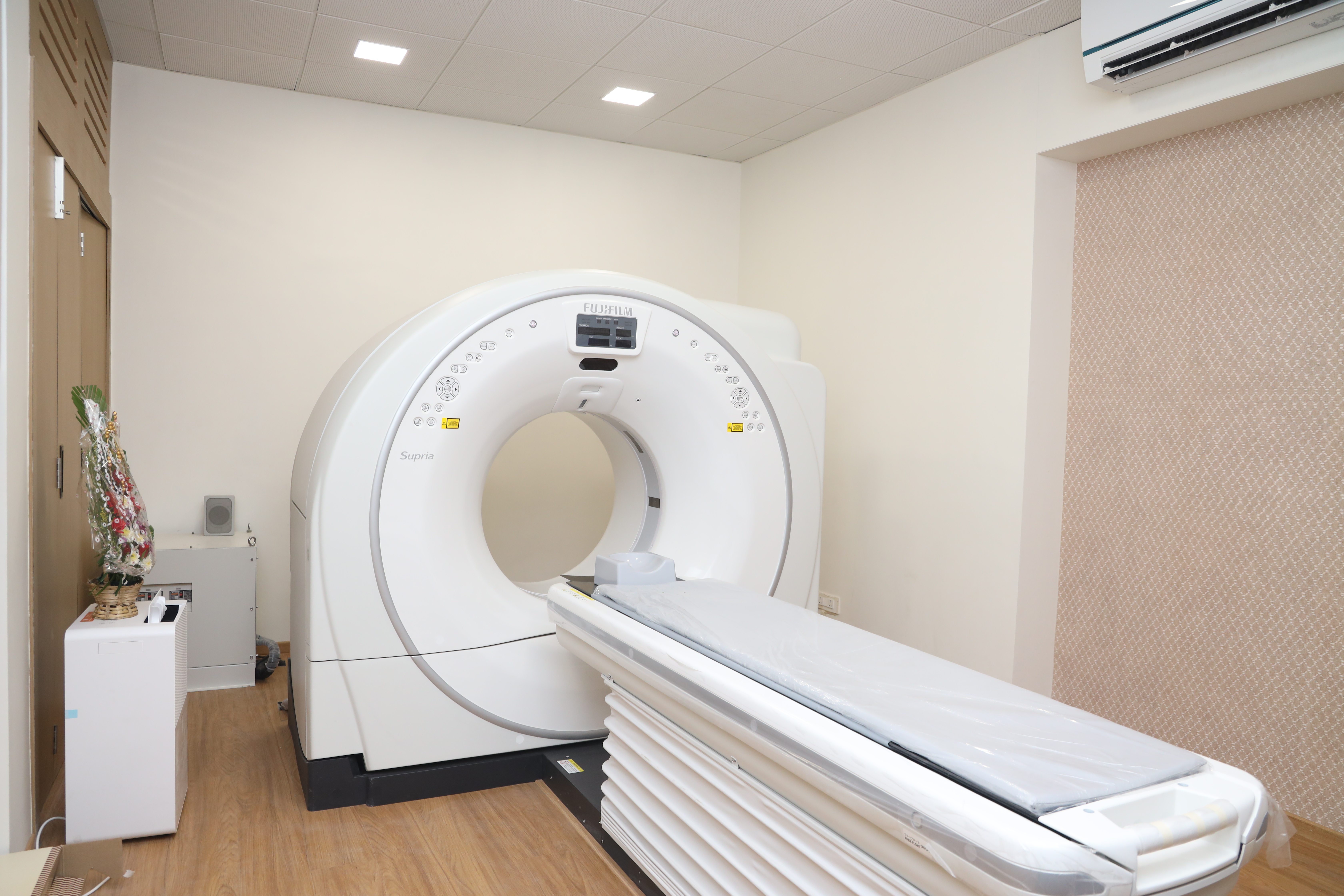
| Scanner | Fujifilm Supria CT |
|---|
| Reported by | Our radiologists, Dr. Avinash Bansal and Dr. Vaishnavi Bansal |
|---|
| Report | Most reports the same day, sent to your WhatsApp |
|---|
| Price | Confirmed on WhatsApp before your visit |
|---|
| Payment | Cashless with most major insurers/TPAs; empanelled for CGHS, ECHS, MJPJAY |
|---|
| Hours | Mon-Sat 8am-10pm, Sun 8am-5pm |
|---|
What a CT brain shows
CT (computed tomography) turns many X-ray pictures into thin slices of the brain and skull, which are viewed in a brain setting and a bone setting. A plain CT brain, often written NCCT brain, needs no injection; CECT brain means contrast is given into a vein. In Hindi it is often called सिर का सीटी स्कैन (sir ka CT scan), and in Marathi डोक्याचा सीटी स्कॅन. It shows:
- Bleeding in or around the brain (haemorrhage). This includes a slow bleed between the brain and its outer covering that can follow even a minor fall in older people (chronic subdural haematoma)
- Skull fractures and injury to the skull base
- Brain swelling and enlarged fluid spaces (hydrocephalus)
- Strokes once they are established, and older 'silent' strokes. A stroke from a blocked artery may not show for several hours, and very small strokes may not show at all
- Calcium deposits and many tumours and cysts, especially larger ones. Small growths and changes low in the back of the brain are better seen on MRI
When doctors ask for a CT brain
Your physician, neurologist or neurosurgeon may ask for it:
- After a minor head injury, once a doctor has examined you, to check for a bleed or fracture
- For an older person who has become more forgetful, unsteady or confused over some weeks, especially after a fall
- Follow-up of a known bleed, hydrocephalus or a brain shunt, or after brain surgery
- When MRI is not possible: some pacemakers and implants, metal fragments, severe claustrophobia or difficulty lying still
- Headache with warning features (see below)
Go straight to a hospital emergency department, not an outpatient scan centre, if there is sudden weakness or numbness of the face, arm or leg, slurred speech, sudden loss of vision or balance, sudden confusion, a sudden severe headache (the worst of your life), headache with fever and a stiff neck, or a first seizure. The same applies to a head injury followed by vomiting, drowsiness, confusion, a seizure or loss of consciousness, and to any head injury in someone taking blood thinners. Stroke treatment is time-critical, and a hospital can scan and treat in the same place. If stroke-like symptoms came and went, please still go to a hospital or get urgent medical advice the same day, because the risk of a full stroke is highest in the next few days.
CT scan for headache: do you need one?
Most headaches, including migraine and tension-type headache, are diagnosed from your history and examination, and a scan usually adds nothing. For a headache that has built up over weeks, MRI shows more and uses no radiation, so doctors often prefer it; CT is chosen when bleeding is the main question or when MRI is not possible.
A sudden, severe headache that peaks within about a minute needs a hospital emergency department, not an outpatient scan, because a small bleed can need tests beyond a CT. For other headaches, doctors ask for imaging when there are warning features such as:
- A new headache after about 50 years of age, or a clear change from your usual pattern
- Headache that keeps getting worse, or wakes you from sleep with vomiting
- Headache with weakness, numbness, unsteadiness, confusion, or problems with vision or speech
- Headache brought on by coughing or straining, or in someone with cancer or low immunity
CT brain or MRI brain?
The two tests answer different questions, and your doctor chooses based on your symptoms. AV Scan does both. If you are not sure what your prescription asks for, send us a photo on WhatsApp and our team will check it with you.
- CT brain: seconds to scan; shows fresh blood, bone and calcium clearly; suits people who cannot have MRI. It uses X-rays.
- MRI brain: no radiation and far more detail of brain tissue, including early strokes, small tumours, multiple sclerosis, epilepsy and the pituitary gland. See brain MRI.
- Blood vessels: for a known or suspected aneurysm or narrowed arteries (not a sudden severe headache, which needs an emergency department), MR angiography shows the vessels without radiation, usually without an injection. See MR angiography of the brain.
- Sinuses: a head CT shows only part of them; for sinusitis, ENT doctors ask for a CT PNS (sinus CT).
How to prepare
Our team confirms the exact preparation for your scan when you book on WhatsApp.
- Plain CT brain: no preparation. Eat, drink and take your usual medicines.
- Contrast CT: about 4 hours without food; water and regular medicines are allowed unless we advise otherwise.
- A recent kidney function (serum creatinine) report may be requested before contrast. If you do not have one, the test can be done at the centre before your scan.
- Tell us about allergies (especially any earlier reaction to contrast dye), asthma, kidney disease or thyroid problems. If you take diabetes medicines such as metformin, we check your kidney function (eGFR) and advise you. Do not stop any medicine on your own.
- If you are or could be pregnant, tell us before booking.
- If you wear an insulin pump or a glucose sensor, tell us when you book; device makers often advise removing or protecting them during a CT.
- Bring your prescription and earlier CT or MRI reports and images for comparison. Hairpins, earrings, spectacles, hearing aids and removable dentures come off before the scan.
What happens during the scan
You lie on your back with your head in a curved support. The scanner is a short, wide ring, not a long tunnel, and only your head goes inside it. You need to keep your head still for the few seconds of scanning, and the technologist can see and hear you throughout.
If contrast is needed, it is given through a small cannula in an arm vein. A brief warm flush, a metallic taste or a feeling of passing urine is common and passes quickly. We check you are well for a short while before removing the cannula, and you can then carry on with your day; drinking a few extra glasses of water that day is sensible unless your doctor has restricted fluids. If you notice a rash, swelling or pain at the injection site, or feel unwell later, contact us or your doctor.
Radiation, contrast and pregnancy
CT uses X-rays. A plain head CT gives a dose roughly similar to the natural background radiation we all receive over several months to about a year. The settings use no more radiation than the clinical question needs, and when there is a clear medical reason the benefit generally outweighs the small risk. Children are more sensitive to radiation, so a child has a CT only when the doctor feels it is needed.
Contrast is added only in specific cases, such as a suspected tumour, spread of cancer, or an infection like an abscess, tuberculosis or neurocysticercosis (tapeworm cysts), particularly when MRI is not possible. Most people tolerate iodine contrast well and serious reactions are rare; you are watched for a short time after the injection so that any reaction can be treated promptly. If you are breastfeeding, you can usually continue as normal.
If you are or could be pregnant, tell us before booking. A head CT gives the baby very little radiation because the baby is well outside the area being scanned, but your doctor and our radiologist will still decide whether the scan should go ahead, be replaced by MRI or wait. Contrast is used in pregnancy only when it is essential. In an emergency, pregnancy is not a reason to delay a head CT that a hospital doctor feels is needed.
Your CT brain at AV Scan, Dadar West
The practical details, including preparation and price, are settled on WhatsApp before you leave home.
- Reported by our radiologists, Dr. Avinash Bansal and Dr. Vaishnavi Bansal (both MD Radiology), who compare it with any earlier scans you bring.
- Scanned on our Fujifilm Supria CT.
- Most reports the same day, sent to your WhatsApp. If the scan shows something that needs urgent attention, we contact your referring doctor directly.
- The exact price is confirmed on WhatsApp before your visit. Send us a photo of your prescription on WhatsApp or call +91 98200 51511.
- Cashless with most major insurers and TPAs; empanelled for CGHS, ECHS and MJPJAY. See insurance and TPA.
- Open Monday to Saturday 8am-10pm and Sunday 8am-5pm.
- Ground floor with step-free entry, on Shankar Ghanekar Marg near Shivaji Park and Siddhivinayak Temple.