At a Glance
| Covers | Neck (cervical), mid-back (dorsal) and lower back (lumbosacral) |
|---|
| Radiation | None |
|---|
| Time on the scanner | Usually about 30-45 minutes for a regional MRI with screening |
|---|
| Preparation | Usually no fasting for a plain scan; confirmed when you book on WhatsApp |
|---|
| Reported by | Dr. Avinash Bansal, MD (Radiology) |
|---|
| Report | Most reports the same day, sent to your WhatsApp |
|---|
| Price | Confirmed on WhatsApp before your visit |
|---|
| Payment | Cashless with most major insurers/TPAs; CGHS, ECHS, MJPJAY empanelled |
|---|
| Open | Mon-Sat 8am-10pm, Sun 8am-5pm; ground floor, step-free |
|---|
What is a whole spine MRI?
The spine has three regions: the cervical spine (neck), the dorsal or thoracic spine (mid-back) and the lumbosacral spine (lower back). MRI shows the discs, the spinal cord and nerve roots, the vertebrae and their bone marrow, and the soft tissues around them. A whole spine MRI includes all three regions in one scan, so problems at different levels are seen together. In Hindi the spine is रीढ़ की हड्डी; in Marathi, पाठीचा कणा.
Which spine MRI has your doctor asked for?
Spine MRI prescriptions are written in a few ways, and the difference changes what the scan can answer. The three common wordings are below; if yours reads differently, our team will confirm what it asks for when you book on WhatsApp. For symptoms from one region only, see our Lumbar Spine MRI and Cervical Spine MRI pages.
- Detailed regional MRI (for example lumbar or cervical spine): images of one region in several planes, including cross-sections through each disc, showing which nerve is pressed and how badly.
- Regional MRI with whole-spine screening (for example "MRI LS spine with whole spine screening"): the detailed regional study plus quicker side-view images of the entire spine, to check the other regions for a problem that could change the diagnosis or treatment.
- Whole-spine screening on its own: survey images of the entire spine, when the question concerns the whole spine, such as whether a known cancer has spread to the vertebrae.
What it can show
Disc bulges and wear-and-tear changes become more common with age and are often seen in adults who have no pain at all, so your doctor reads the report together with your symptoms and examination.
- Disc bulge or prolapse ("slip disc") at one or more levels
- Narrowing of the spinal canal (stenosis), sometimes in the neck and lower back together
- Pressure on the spinal cord, and signal changes within the cord that can go with cord damage (myelopathy)
- Collapsed vertebrae (compression fractures), and whether a collapse looks recent or old
- Infection of the discs and vertebrae, including spinal tuberculosis
- Spread of cancer to the spine (metastases) and marrow disease such as myeloma
- Spinal cord conditions such as inflammation or demyelination (for example multiple sclerosis) or a syrinx (fluid cavity in the cord); small cord lesions may need dedicated cord images to be seen fully
When doctors ask for it
Doctors add whole-spine screening, or request the whole spine, when the answer may not sit in one region:
- Symptoms in more than one place, such as arm tingling with sciatica
- Difficulty walking, poor balance or clumsy hands: pressure on the cord in the neck can cause leg symptoms that look like a lower-back problem
- A known cancer (for example breast, prostate, lung or kidney) with new back pain
- Suspected spinal infection, including tuberculosis, which can affect levels that are not next to each other
- Several painful levels in osteoporosis, or pain after a minor fall or strain
- Planning or follow-up of spine surgery, when the surgeon wants the levels above and below
Go to a hospital emergency department first, not a routine MRI appointment, if you have sudden weakness of the arms or legs, numbness between the legs or around the back passage, loss of bladder or bowel control, new difficulty passing urine, or neck or back pain after a significant fall or accident. The same applies to back pain with new leg weakness or numbness if you have a known cancer, and to back pain with fever and feeling unwell.
How to prepare
Our team confirms the exact preparation for your scan when you book on WhatsApp.
- For a plain (non-contrast) MRI you can usually eat, drink and take your regular medicines. If contrast is planned, you may be asked not to eat for a short time before; our team will tell you if this applies.
- Take any prescribed painkillers as usual; lying still is easier when pain is controlled. Do not stop any regular medicine unless your doctor or our team advises it.
- Wear loose clothes without metal; you may be asked to change into a gown. Leave jewellery, hairpins, watches, phones and cards outside the scan room.
- Bring your prescription and previous spine MRI, CT or X-ray reports and images, plus operation notes and implant details if you have had spine surgery.
- Tell us when booking about a pacemaker or defibrillator, cochlear implant, spinal cord or other nerve stimulator, implanted drug pump, programmable brain shunt, aneurysm clips, metal fragments in the eyes (for example from welding), or spinal rods and screws.
- Tell us about an insulin pump, glucose sensor or medicine skin patch, as some need to be removed before the scan.
- Tell us if you are or might be pregnant, or find it hard to lie flat or be in enclosed spaces.
What happens during the scan
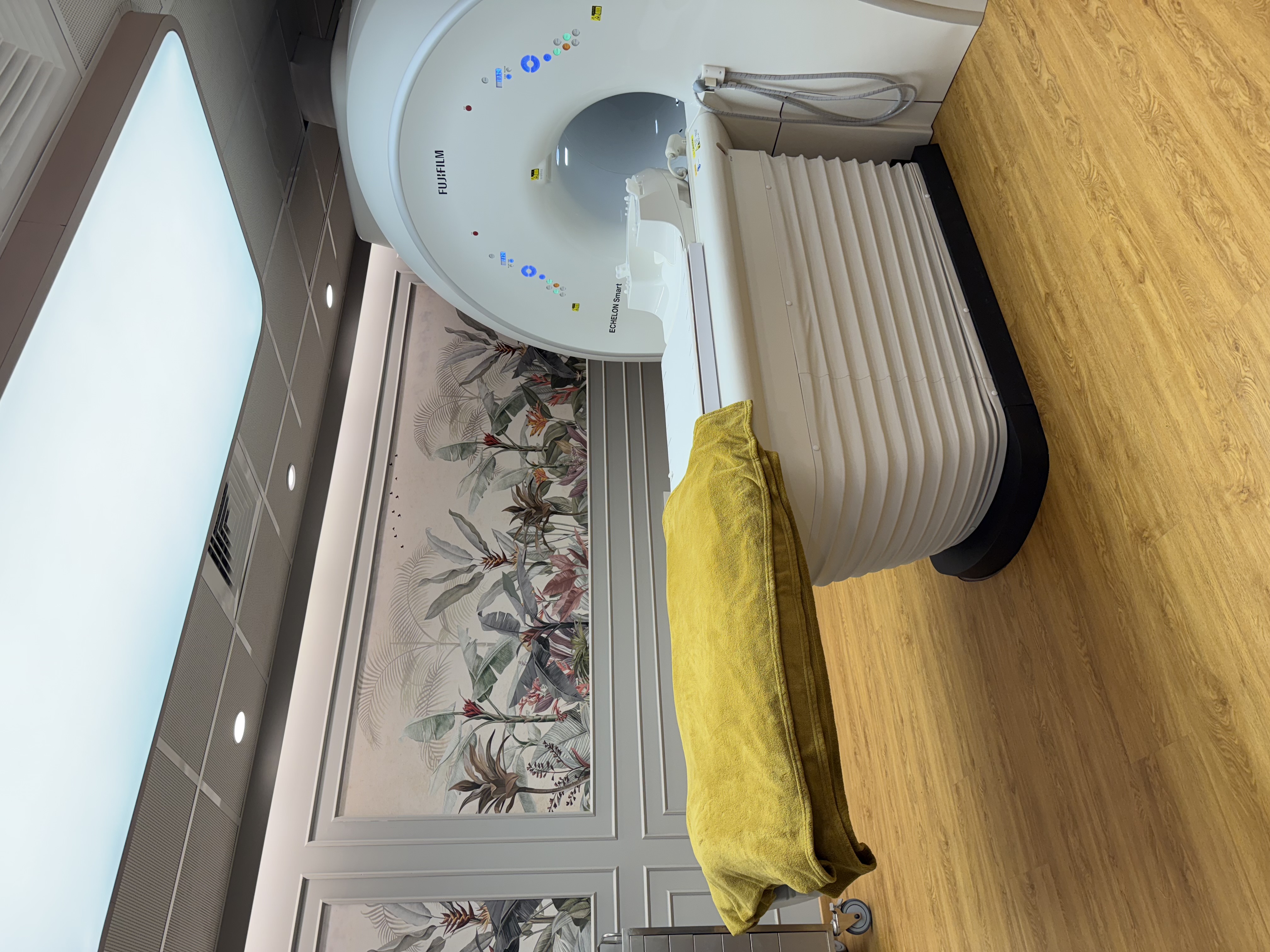
You lie on your back on a padded table that contains the spine coil, usually with a coil around your neck as well, and the table moves into the scanner. It makes knocking sounds as it takes each set of images; the ECHELON Smart is designed for quieter scanning, you are given ear protection, and you can listen to music. Our MRI team can speak to you between sets, and you hold a call button.
Keeping still matters most, because movement blurs the images. A regional MRI with whole-spine screening usually takes about 30-45 minutes on the table, and screening alone often about 15-30 minutes; a contrast injection adds some time. After a plain MRI you can carry on as usual.
Safety and contrast
MRI uses no ionising radiation. The scanner's magnet is always on, so the main safety concern is metal and electronic implants and loose metal objects; you fill in a safety checklist and our team goes through it with you before the scan.
Most whole-spine MRIs need no contrast. A gadolinium contrast injection into an arm vein may be needed for suspected infection, a tumour, spinal cord inflammation, or after spine surgery to tell scar tissue from a new disc prolapse. Reactions are uncommon and usually mild. If contrast is planned:
- A recent kidney function (serum creatinine) report may be requested, because contrast is used with extra care when the kidneys work poorly
- Mention kidney disease or dialysis, any previous reaction to contrast, other allergies or asthma
- Mention diabetes and your diabetes medicines, including metformin, and your other regular medicines; our team will tell you if any change is needed
- Mention if you are or might be pregnant; contrast is generally avoided in pregnancy unless it is essential
- Mention if you are breastfeeding; our team will advise you
Your whole spine MRI at AV Scan
WhatsApp or call +91 98200 51511, or book online. You can share your prescription on WhatsApp so our team can check which spine study has been requested.
- Reported by Dr. Avinash Bansal, MD (Radiology), whose work covers MRI, CT and musculoskeletal imaging
- Fujifilm ECHELON Smart 1.5T MRI with quieter scanning and in-scanner music
- Most reports the same day, sent to your WhatsApp
- Exact price confirmed on WhatsApp before your visit
- Cashless with most major insurers and TPAs; empanelled for CGHS, ECHS and MJPJAY. Ask on WhatsApp whether your policy or scheme covers this scan
- Open Monday-Saturday 8am-10pm and Sunday 8am-5pm
- Ground floor and step-free, near Shivaji Park and Siddhivinayak Temple