At a Glance
| Test | TMT / treadmill stress test (exercise ECG) |
|---|
| What it checks | ECG, heart rate, blood pressure and symptoms during exercise |
|---|
| Time at the centre | About 1 to 1.5 hours; the walking part usually lasts about 6-12 minutes |
|---|
| Food | Light meal, finished about 3 hours before the test |
|---|
| Wear | Walking or sports shoes and loose clothes |
|---|
| Medicines | Do not stop any unless your doctor tells you to |
|---|
| Radiation | None |
|---|
| Report | Most reports the same day, sent to your WhatsApp |
|---|
| Price | Exact price confirmed on WhatsApp before your visit |
|---|
What a TMT checks
A narrowed heart artery may carry enough blood at rest but not when the heart is working hard. A TMT records a continuous 12-lead ECG and regular blood pressure readings while you walk, to bring out changes that appear with effort. It is also called a treadmill test, stress test or exercise ECG, and many patients simply say ट्रेडमिल टेस्ट.
- ECG changes during or after exercise that can suggest reduced blood supply to the heart muscle (ischaemia)
- How your heart rate and blood pressure respond to effort and settle afterwards
- Symptoms such as chest discomfort, breathlessness or dizziness, and the effort level at which they start
- Irregular heartbeats brought on by exercise
- Your exercise capacity: how long and how hard you can walk
When doctors ask for a TMT
A TMT is usually requested by your physician or cardiologist, who reads it together with your symptoms, risk factors, resting ECG and any 2D echo. Common reasons:
- Chest discomfort, tightness or breathlessness that comes on with walking or climbing stairs and settles with rest
- Diabetes, high blood pressure, high cholesterol, smoking or a family history of heart disease, especially if you also have symptoms
- Known heart disease, or after angioplasty (a stent) or bypass surgery, when symptoms change or your cardiologist wants to check your exercise capacity
- Palpitations during exercise
- A fitness check your doctor has asked for, for example before starting a strenuous exercise programme
When a TMT is not done, or needs to wait
Your history, resting ECG and blood pressure are checked first, and the test is not started if it is not safe that day. If you have ever fainted or nearly fainted during exercise, see your doctor before booking; a 2D echo and a cardiologist's opinion usually come first. Tell us when you book if you have a pacemaker or ICD (bring the device card), or if you are or may be pregnant.
Some resting ECG patterns (such as a left bundle branch block or a pacemaker rhythm) and some medicines such as digoxin make the exercise ECG hard to read, so your doctor may choose a different test.
A TMT is usually avoided or postponed if you have:
- Chest pain at rest, new or worsening chest pain, or a recent heart attack
- Very high blood pressure on the day
- An uncontrolled irregular heartbeat, or heart failure that is not under control
- Severe narrowing of the aortic valve (aortic stenosis) with symptoms, or a thickened heart muscle condition (hypertrophic cardiomyopathy) - tell your doctor first
- Fever or another acute illness, recent inflammation of the heart or its lining (myocarditis or pericarditis), or a recent clot in the legs or lungs
- A known large aortic aneurysm or a tear in the aorta
- Knee, hip or balance problems that make treadmill walking unsafe
Chest pain now, or chest pain at rest, needs urgent care, not a TMT booking. If chest pain or pressure is severe, lasts more than a few minutes, or comes with sweating, breathlessness, vomiting or fainting, go to the nearest hospital emergency department straight away (call 108 for an ambulance). The same applies if such symptoms start after a TMT.
How to prepare for a TMT
Our team confirms the exact preparation when you book on WhatsApp. The usual guidance:
- Have a light meal, finished about 3 hours before the test. Do not come after a long fast, especially if you have diabetes.
- No tea, coffee, cola, energy drinks or smoking for at least 3 hours before.
- Wear walking or sports shoes (not slippers or heels) and loose clothes, and skip body oil or lotion on the chest so the ECG stickers hold. Men may need small patches of chest hair clipped.
- Do not stop any heart or blood pressure medicine on your own. Some, such as beta-blockers, change how the heart responds to exercise, so the doctor who requested the TMT may ask you to pause them.
- Tell us if you have taken sildenafil, tadalafil or a similar medicine in the last 2 days: with these, nitrate medicines used for chest pain can cause a dangerous fall in blood pressure.
- If you have diabetes, ask your doctor how to take your tablets or insulin that day, and bring a small snack or glucose.
- Bring your doctor's prescription, a list of your medicines, older ECG, echo or TMT reports, and your inhaler or chest-pain spray if you use one.
- If fasting blood tests such as a lipid profile are also due, tell us so the tests can be planned in the right order; blood samples are collected at the centre.
What happens during the test
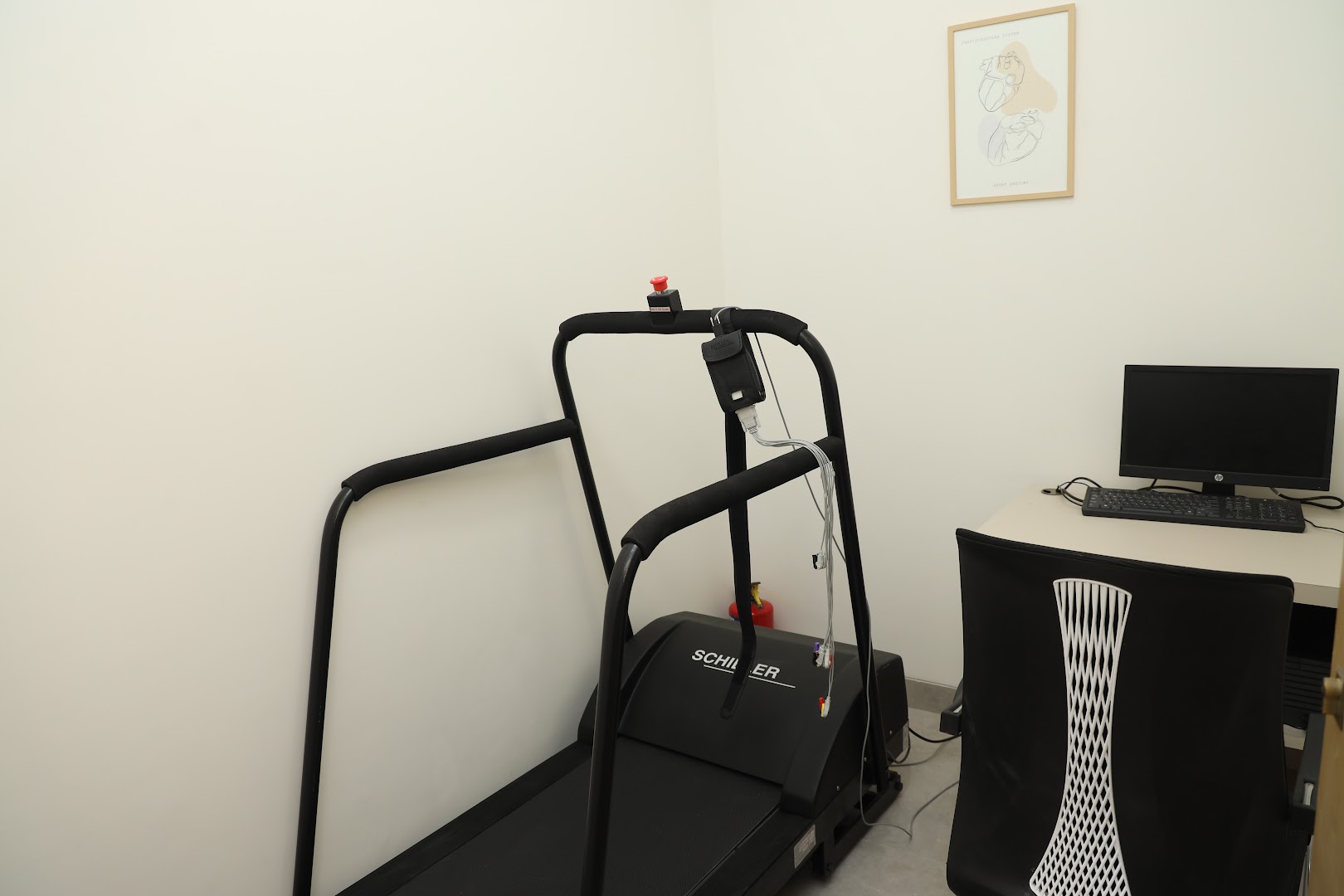
Ten small sticky electrodes are placed on your chest and a blood pressure cuff on your arm, and a resting ECG is recorded first. You start walking slowly; every few minutes the treadmill's speed and slope increase in stages, following a standard protocol, with your ECG watched throughout and your blood pressure checked at each stage.
The walking part usually lasts about 6-12 minutes, depending on your age and fitness. It usually aims to reach a target heart rate for your age, or continues until you are too tired to go on. Monitoring continues for several minutes while you rest, because some changes appear only in recovery. Plan on about an hour to an hour and a half at the centre. Most people go home and carry on as normal; avoid a very hot bath or shower for about an hour.
- Tell the staff at once if you feel chest pain, unusual breathlessness, dizziness or leg pain.
- You can ask to stop at any time, and the test is stopped early if your ECG, blood pressure or symptoms show a problem.
Safety, and what the result means
A TMT uses no radiation and no injection. Serious problems during a supervised TMT, such as a heart attack or a dangerous heart rhythm, are rare, though not impossible, which is why the safety checks above come first. Feeling tired, sweaty and out of breath at the end is normal.
A TMT is a useful first test, not a final answer. A normal result is reassuring but does not completely rule out narrowed heart arteries, and a positive result does not always mean a blockage; false alarms are more common in some groups, including women. Your doctor may then advise further tests, such as a CT scan of the heart arteries (CT coronary angiography), cardiac MRI in selected cases, or a cardiologist's opinion, which may lead to a coronary angiogram.
TMT at AV Scan, Dadar West
AV Scan is a doctor-owned centre at Shilpa Apartment, Shankar Ghanekar Marg, Dadar West / Prabhadevi.
- By appointment, under medical supervision, with continuous 12-lead ECG and blood pressure checks through the test and recovery
- ECG and 2D echo, PFT (lung function test) and blood tests at the same centre, if your doctor has asked for them
- Most reports the same day, sent to your WhatsApp
- Exact price confirmed on WhatsApp before your visit
- Cashless with most major insurers and TPAs; empanelled for CGHS, ECHS and MJPJAY (ask on WhatsApp whether your TMT is covered)
- Ground floor with step-free entry, near Shivaji Park and Siddhivinayak Temple (directions)
- The centre is open Monday to Saturday 8am-10pm and Sunday 8am-5pm; the TMT is by appointment, so please book your slot on WhatsApp