At a Glance
| Food and drink | Usually as normal; MRCP about 4-6 hours without food (water allowed); some abdominal, pelvic and contrast scans as advised |
|---|
| Medicines | Take as usual with water unless our team or your doctor advises otherwise |
|---|
| Tell us before booking | Pacemaker or other implant, metal in the eye, pregnancy, kidney disease, fear of closed spaces |
|---|
| What to wear | Loose clothes without metal; you may be asked to change into a gown |
|---|
| Time in the scanner | Usually about 15-45 minutes, depending on the body part; longer with contrast or more than one area |
|---|
| If you are anxious | Noise-reduction features, in-scanner music, a team member talking to you; sedation under an anaesthesiologist when needed |
|---|
| Contrast | Only for some scans; a creatinine test can be done at the centre if needed |
|---|
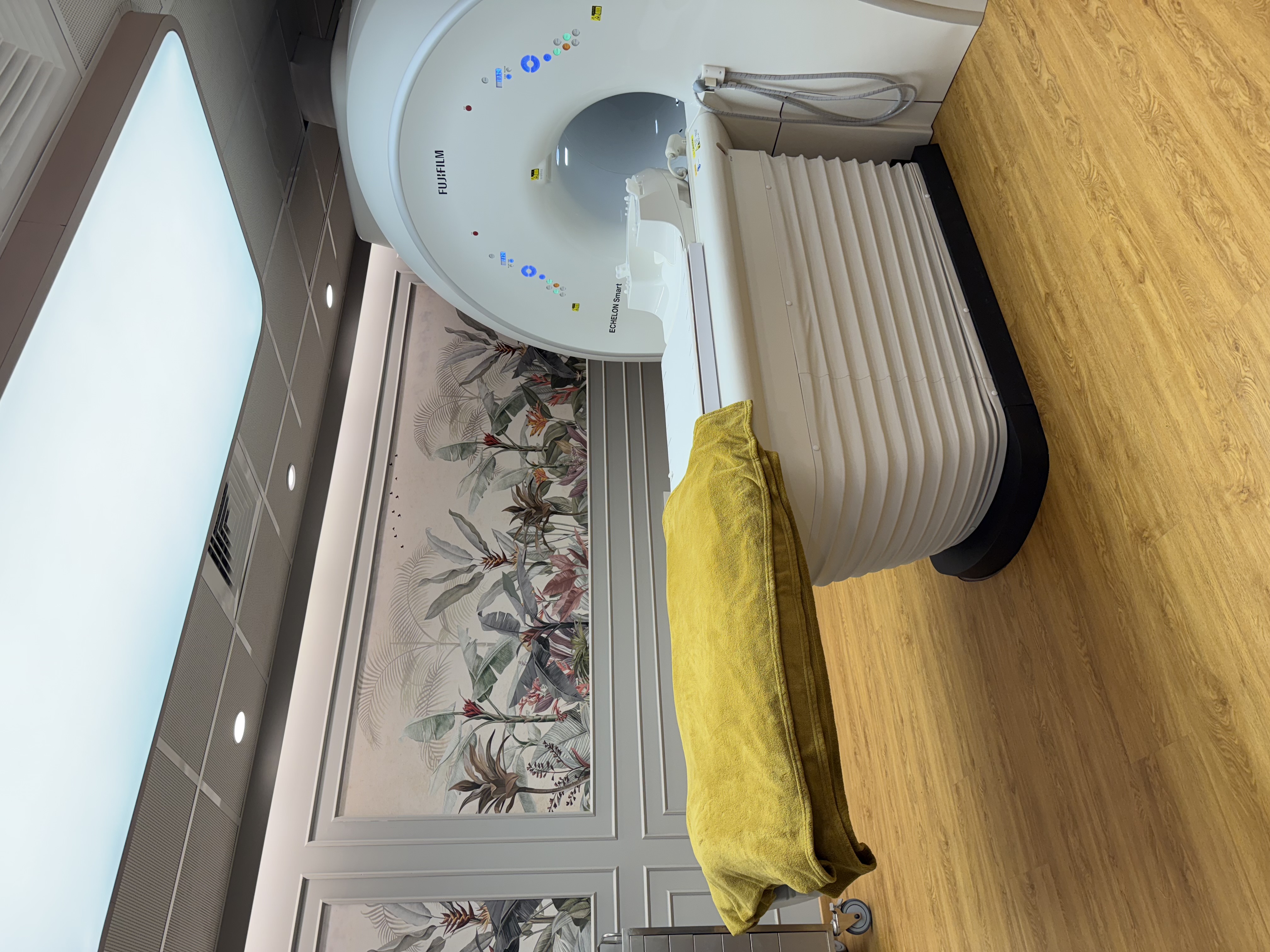
| Scanner | Fujifilm ECHELON Smart 1.5T MRI |
|---|
| Reported by | Our radiologists, Dr. Avinash Bansal and Dr. Vaishnavi Bansal |
|---|
| Report | Most reports the same day, sent to your WhatsApp |
|---|
| Price | Exact price confirmed on WhatsApp before your visit |
|---|
| Hours and access | Mon-Sat 8am-10pm, Sun 8am-5pm; ground floor, step-free |
|---|
Step 1: When you book, tell us about implants and your health
Preparation (MRI की तैयारी in Hindi, MRI ची तयारी in Marathi) starts when you book. Send a photo of your prescription on WhatsApp; our team confirms the scan, whether contrast is planned, the preparation and the exact price. Before booking, tell us about:
- A pacemaker or defibrillator, cochlear implant, nerve stimulator, implanted medicine pump, programmable brain shunt, brain aneurysm clip, breast tissue expander, or any other electronic or magnetic implant
- Metal in the eye at any time, work involving metal grinding or welding, or shrapnel or bullet fragments in the body; if metal in the eye cannot be ruled out, an X-ray of the eyes may be advised first
- Heart valves, stents, joint replacements, plates, screws or a copper-T (most allow MRI, but we need the details, especially if the surgery was recent)
- An insulin pump, glucose sensor or medicine skin patch: these usually must come off before you enter the scanner room, so check with your doctor beforehand and bring a spare or replacement. Do not remove a pain-relief or heart patch without your doctor's advice
- Pregnancy, possible pregnancy or breastfeeding; kidney disease or dialysis, allergies, and diabetes and its medicines such as metformin
- Fear of closed spaces, or difficulty lying flat or keeping still
An MRI is a planned test. If you have sudden weakness or numbness of the face, arm or leg, difficulty speaking, a sudden severe headache, or back pain with new numbness around the back passage or loss of bladder or bowel control, go to a hospital emergency department first.
Pacemakers and other implants
Some pacemakers and MR-conditional implants can be scanned under supervision, following the device's own conditions; others cannot. For a pacemaker or defibrillator, the whole system (the device and its leads) must be MR-conditional, the device usually has to be checked and switched to an MRI setting before the scan and back afterwards, and a recently implanted device may need to wait. A previous MRI elsewhere does not by itself prove that an implant is safe, so share the device card or surgery papers and our team checks before you travel. If MRI is not possible, your doctor may choose another test, such as a CT scan.
Step 2: Food, drink and medicines
Our team confirms the exact preparation when you book on WhatsApp. As a general guide:
- Brain, spine and joint MRI (such as knee, shoulder or ankle): usually no fasting; eat and drink as normal
- MRCP: usually nothing to eat for about 4-6 hours beforehand; water is allowed
- Other abdominal and pelvic MRI, and contrast scans: you may be asked to avoid food for a few hours
- Medicines: take them as usual with water. If you have diabetes and are asked to fast, tell us so the timing can be planned, and ask your doctor how to adjust your diabetes medicines that day
- Prostate, cardiac and fetal MRI have their own instructions
Step 3: What to wear, and what to leave outside
The MRI magnet is always on. It pulls loose metal towards it, can warm some metals and can wipe bank cards.
- Wear loose clothes without metal zips, hooks, studs or an underwired bra. You may be asked to change into a gown, because some sports and 'anti-odour' fabrics contain metal threads that can heat up
- Remove all jewellery, including mangalsutra, bangles, nose pins, toe rings and piercings, as well as hairpins and clips, watches, hearing aids and removable dentures or dental plates with metal
- Phones, cards, coins and keys stay outside the scanner room
- Avoid eye make-up, including kajal, and glittery hair products, which can contain metal particles
- Tattoos and permanent make-up are usually fine; tell the team at once if one feels warm or tingles during the scan
Step 4: What to bring
- Your prescription, and earlier reports and images of the same area for comparison
- Your implant card or surgery papers, if you have an implant
- A recent kidney function (creatinine) report if contrast is planned; if you do not have one, the test can be done at the centre before the scan
- Photo ID and, for cashless billing, your insurance card or your CGHS, ECHS or MJPJAY documents (see insurance and TPA)
- An adult to take you home, if sedation is planned
Step 5: What happens during the scan
A team member goes through a metal-safety checklist with you, and if contrast is planned a small cannula is placed in an arm vein. You lie on a padded table with a light receiver pad (coil) over the part being scanned, ear protection on and a call bell in your hand. For knee, ankle and foot scans you go in feet first, so your head usually stays near the opening or outside the scanner.
The scanner makes loud knocking sounds while it takes pictures. Keep still, because movement blurs the images, and follow the breath-hold instructions for abdominal scans. Do not cross your arms or legs or clasp your hands, because skin-to-skin contact can cause warming, and press the call bell if you feel warm or uncomfortable. If contrast is needed, it is usually injected partway through the scan and may feel briefly cool in the arm. Time in the scanner is usually about 15-45 minutes, depending on the body part, and longer with contrast or more than one area.
Claustrophobia and MRI sedation
If closed spaces make you anxious, tell us when you book so we can plan. The Fujifilm ECHELON Smart 1.5T MRI has noise-reduction features for parts of the scan, although it is still loud enough that ear protection is always used, and in-scanner music is available. A team member can talk to you between parts of the scan and tell you how long each part lasts. The scanner is a lit tunnel, open at both ends, and many people find it easier to close their eyes before the table moves in.
If you are still very anxious, sedation is available when needed, under the supervision of an anaesthesiologist. It needs a period without food, which our team explains. Afterwards an adult must take you home, and for 24 hours you should not drive, operate machinery, drink alcohol or sign important documents. Do not take a sleeping or anxiety tablet before the scan unless your own doctor has prescribed it for this purpose; if you do take one, tell us, and do not drive yourself home.
Contrast, injections and pregnancy
Most brain, spine and joint MRIs need no contrast. A gadolinium contrast injection may be added for some scans, for example to assess a tumour, infection or inflammation; it is different from the iodine dye used for CT. Reactions are uncommon and usually mild, such as nausea, itching or a rash; tell the team at once if you feel unwell, itchy or breathless after the injection. A recent kidney function (creatinine) report may be requested, and the test can be done at the centre if needed. If your kidneys work poorly or you are on dialysis, the radiologist decides whether contrast is needed, because of a rare complication in people with severe kidney disease.
Mention allergies, asthma, any past reaction to contrast, kidney disease and diabetes medicines such as metformin. Metformin does not usually need to be stopped for an MRI contrast injection, and our team advises you. Tiny amounts of gadolinium can stay in the body for a long time; no harm from this has been shown in people with normal kidney function, and contrast is given only when it adds useful information.
An antispasmodic injection to relax the bowel is sometimes used for MRCP or pelvic MRI. It can cause a dry mouth, a fast heartbeat and blurred vision for a short time, so do not drive until your vision is clear. Tell us if you have glaucoma, heart disease or heart rhythm problems, myasthenia gravis, or prostate or urine-flow problems. If you develop a painful red eye, or blurred vision that does not clear within a few hours, seek urgent medical help.
If you are, or might be, pregnant, tell us before booking. MRI without contrast can be done in pregnancy when your doctor feels the information is needed now; gadolinium contrast is generally avoided unless it is essential. Breastfeeding does not usually need to stop after MRI contrast.
After the scan and your report
If you had no sedation and no antispasmodic injection, you can usually go home, eat, drive and return to work straight away. MRI uses a magnet and radio waves, not X-rays, so there is no X-ray radiation. Your scan is reported by our radiologists, Dr. Avinash Bansal and Dr. Vaishnavi Bansal: most reports the same day, sent to your WhatsApp.
Your MRI at AV Scan, Dadar West
To book, WhatsApp or call +91 98200 51511, or use our booking page. Not sure which scan you need? See our guides on back pain, headache and knee pain, or read about MRI scans at AV Scan.
- Fujifilm ECHELON Smart 1.5T MRI with in-scanner music; see our equipment
- Reported by our radiologists, Dr. Avinash Bansal and Dr. Vaishnavi Bansal, both MD (Radiology) and FMF (UK) certified
- A metal-safety checklist completed with you before the scan; see quality and safety
- Exact price confirmed on WhatsApp before your visit; cashless with most major insurers and TPAs, and empanelled for CGHS, ECHS and MJPJAY
- Open Monday to Saturday 8am-10pm and Sunday 8am-5pm
- Ground floor with a step-free entrance, Shankar Ghanekar Marg, near Shivaji Park and Siddhivinayak Temple