At a Glance
| Full form | CT of the Kidneys, Ureters and Bladder |
|---|
| Also written as | Plain CT KUB, NCCT KUB, stone-protocol CT |
|---|
| Injection | CT KUB: none. CT urography: contrast into an arm vein |
|---|
| Preparation | CT KUB: usually no fasting. CT urography: usually a few hours without solid food, and a creatinine report may be requested. Confirmed on WhatsApp when you book |
|---|
| Time | CT KUB: usually about 10-15 minutes in the scan room. CT urography: allow about an hour at the centre |
|---|
| Reported by | Dr. Avinash Bansal, MD (Radiology) |
|---|
| Report | Most reports the same day, sent to your WhatsApp |
|---|
| Price | Confirmed on WhatsApp before your visit |
|---|
| Payment | Cashless with most major insurers and TPAs; empanelled for CGHS, ECHS and MJPJAY |
|---|
| Hours and access | Mon-Sat 8am-10pm, Sun 8am-5pm; ground floor, step-free |
|---|
What a CT KUB shows
Prescriptions may call it plain CT KUB, NCCT KUB (non-contrast CT) or stone-protocol CT. Almost all kidney stones show clearly on CT without any dye, so no injection is needed.
A plain CT KUB does not show how well each kidney is working, and it gives only limited detail of the kidney tissue and nearby organs. If it finds something other than a stone, your doctor may advise a contrast CT, an ultrasound or another test.
Kidney stone in Hindi: गुर्दे की पथरी; in Marathi: मुतखडा.
- Stones in the kidneys, ureters or bladder, including uric acid stones that do not show on X-ray
- Each stone's size in millimetres and exact position, which help your doctor judge whether it may pass on its own
- Signs of blockage, such as swelling of the kidney (hydronephrosis) or of the ureter above a stone
- Stone density, one of the details a urologist uses when choosing between treatments such as lithotripsy, ureteroscopy or PCNL
- Fragments left after treatment, and sometimes a different cause for the pain
Which scan for kidney stones?
Each test answers a different question, and your doctor chooses based on your symptoms, your age and whether you are pregnant. As a general guide:
- Ultrasound KUB (sonography / USG KUB): no radiation, so it is the first test in pregnancy, in children and often for follow-up. It shows kidney stones, kidney swelling, the bladder and, in men, the prostate, but very small stones, and stones in the middle of the ureter hidden by bowel gas, can be missed. It needs a full bladder.
- X-ray KUB: a quick, low-dose picture, used to follow a stone already known to show on X-ray or to check the position of a DJ stent. Uric acid stones and small stones lying over bone may not be seen.
- Plain CT KUB: usually preferred for an adult with typical stone pain, when ultrasound is unclear, and before stone treatment is planned.
- CT urography (CECT urography): for blood in the urine that needs full investigation, a suspected growth in the lining of the urinary tract, unusual anatomy or planning complex surgery. It is not needed just to find a stone.
When doctors request CT KUB or CT urography
CT KUB is usually requested for sudden colicky pain in the side or back spreading to the groin (renal colic), blood in the urine with pain, a swollen kidney on ultrasound, repeated stones, and before and after stone treatment. CT urography is usually requested for:
- Visible blood in the urine without a clear cause, or blood found on urine tests when your doctor considers the risk higher, for example in older adults and people who smoke
- A suspected growth in the lining of the kidney, ureter or bladder, or follow-up after treatment for one
- Showing the anatomy of a narrowing where the kidney drains into the ureter (PUJ obstruction), a duplex kidney or other variations. How well the kidney drains is judged with a separate kidney function scan
- Planning complex stone surgery
Please go to a hospital emergency department first, rather than booking a scan, if you have side or back pain together with fever or shivering, pain that painkillers do not control, being unable to pass urine, or repeated vomiting; if you are pregnant and in severe pain; or if you are in pain and have only one working kidney or a kidney transplant. A blocked kidney with infection needs urgent hospital treatment. If you are over 60 and have sudden severe back or side pain for the first time, also go to an emergency department first, because other serious conditions can feel like stone pain.
How to prepare
Plain CT KUB: usually no fasting. You may be asked to drink a few glasses of water beforehand so your bladder is comfortably full, which helps show stones near the bladder.
CT urography: you may be asked to avoid solid food for about 4 hours before; plain water is generally allowed, and you may be asked to drink extra water shortly before the scan so the urinary tract fills well. A recent kidney function (serum creatinine) report may be requested; if you do not have one, tell us when you book.
Our team confirms the exact preparation when you book on WhatsApp. For either test:
- Tell us if you are, or might be, pregnant, or are breastfeeding
- Tell us about any previous reaction to contrast (dye), asthma or serious allergies
- Tell us if you have kidney disease, a single kidney or diabetes, especially if you take metformin. Do not stop any medicine on your own; we will tell you if anything needs to change
- Tell us if you have an overactive thyroid, or a thyroid scan or radioactive iodine treatment is planned, as the contrast contains iodine
- Bring your prescription and earlier ultrasound, X-ray or CT reports and CDs for comparison
- Wear loose clothes without metal
What happens during the scan
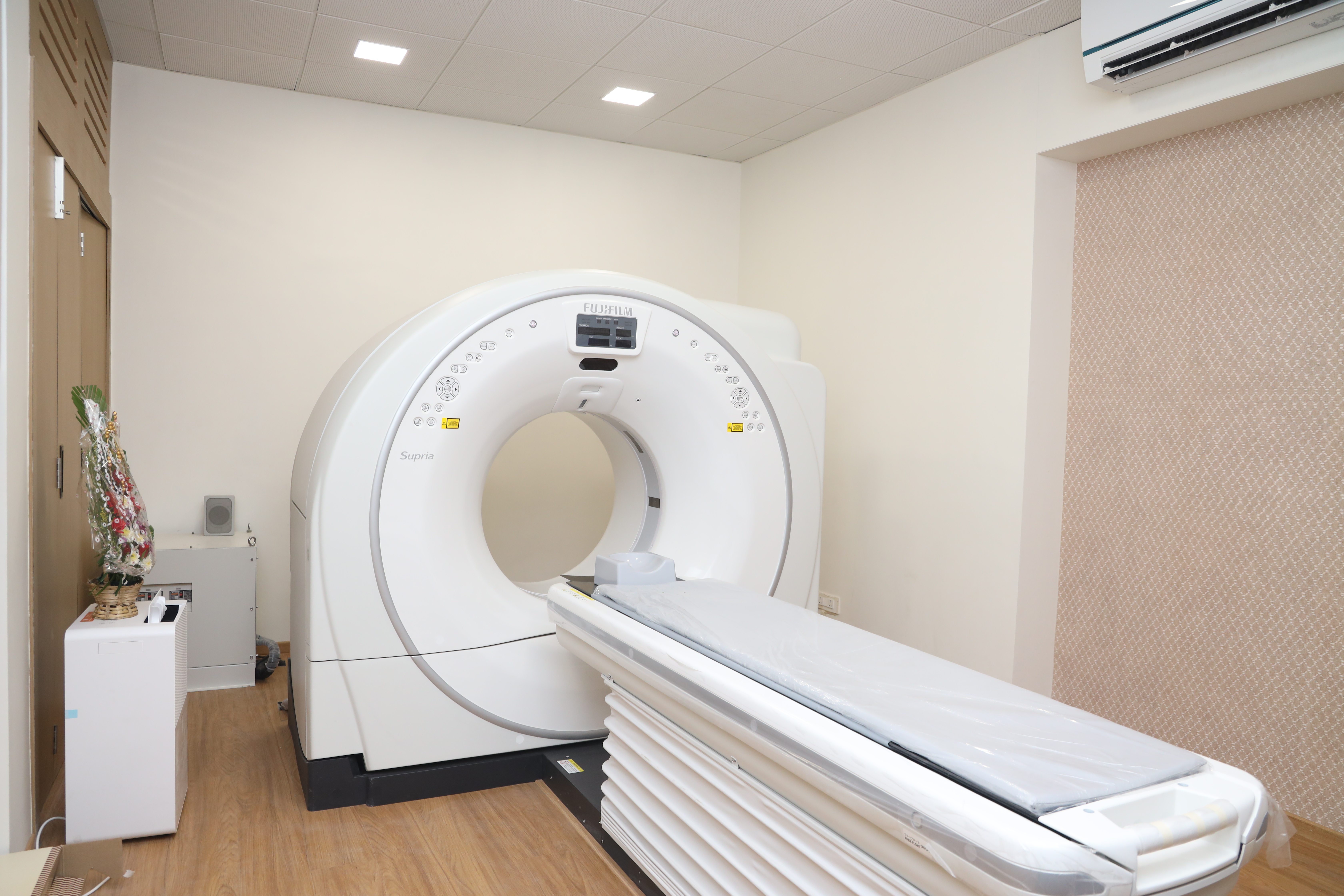
Plain CT KUB: you lie on your back on the table, which moves through a short, open ring (not a closed tunnel), and hold your breath for a few seconds when asked. It is painless, and you are usually in the scan room for about 10-15 minutes. You can eat and carry on with your day straight after.
CT urography: a small cannula is placed in a vein in your arm, plain images are taken, and then the contrast is injected. A brief warm flush, a metallic taste or a feeling of having passed urine is common, harmless and settles within a minute or two. Tell the team at once if you feel pain or swelling at the cannula site, itching or difficulty breathing. Further images follow after a wait of several minutes, once the contrast reaches the ureters and bladder. Allow about an hour at the centre, including a short wait after the injection so the team can check you feel well. Afterwards, drink plenty of water unless your doctor has asked you to limit fluids.
Safety: radiation and contrast
CT uses X-rays. A stone study is usually planned at a lower dose than a routine abdominal CT and adjusted to your body size. CT urography takes images in more than one phase, so its dose is higher than a plain CT KUB. When your doctor considers the test necessary, the expected benefit is generally greater than the small risk, but CT should not be repeated without reason, which is why ultrasound or X-ray KUB is often used for follow-up. Tell us before any CT or X-ray if you are or might be pregnant.
The iodine-based contrast used for CT urography is well tolerated by most people. Mild reactions such as itching, a rash or nausea can occur, and serious reactions are rare. A rash can occasionally appear a day or two later; tell us or your doctor if it does. Checking kidney function, and knowing about allergies, thyroid problems and diabetes medicines beforehand, helps identify anyone who needs extra precautions. Breastfeeding can usually continue normally after the injection.
CT KUB and CT urography at AV Scan, Dadar West
Both are reported by Dr. Avinash Bansal, MD (Radiology), FMF (UK) certified, whose work here covers CT, MRI, musculoskeletal and interventional imaging.
- Multi-slice CT; stone studies are planned as plain scans, with contrast only when the clinical question needs it
- Ultrasound KUB (GE Voluson E10 and Philips Affiniti 70G), X-ray KUB, CT KUB and CT urography are all done in the same building, so if a CT is advised after your sonography you do not need to go elsewhere
- The exact price is confirmed on WhatsApp before your visit; send a photo of your prescription to +91 98200 51511
- Cashless with most major insurers and TPAs; empanelled for CGHS, ECHS and MJPJAY
- Most reports the same day, sent to your WhatsApp
- Open Monday to Saturday 8am-10pm and Sunday 8am-5pm; for CT urography, our team confirms a suitable time when you book
- Ground floor and step-free, which matters when you are in pain; near Shivaji Park and Siddhivinayak Temple