
Fatty liver on my sonography report: do I need a liver stiffness test?
Tests reported by our radiologists
Not always, but you should be checked for scarring. The sonography grade shows how much fat is in your liver, not whether it is scarred, and scarring matters more. Guidelines suggest a FIB-4 blood score, then a liver stiffness test (elastography) if that score is not low. At AV Scan it is usually done with your abdominal sonography.
At a glance
- What the sonography grade shows
- How much fat is in the liver (mild, moderate or severe), not whether it is scarred
- What the stiffness test shows
- How stiff the liver is, which estimates scarring (fibrosis); no needle, no radiation and no injection
- Liver fat
- In the same visit, our ultrasound machine can also estimate how much fat is in the liver
- Usual order
- A FIB-4 blood score to start with, then the stiffness test if that score is not low
- Done with
- Usually your abdominal sonography, in the same visit. If your prescription asks only for the sonography and it shows fatty liver, the stiffness test can be added the same day after a call to your doctor
- Preparation
- About 4 to 6 hours without food beforehand; you can drink plain water freely
- Time
- The stiffness readings take about 10 to 15 minutes; about 30 to 40 minutes in all with the abdominal sonography
- Report
- Reported by our radiologists; most reports the same day, sent to your WhatsApp
- Hours
- Ultrasound, including the stiffness test: Monday to Saturday; evenings 6 pm onwards by prior appointment; no ultrasound on Sundays
- Cost
- We tell you the exact figure on WhatsApp before you book.
What does fatty liver on my sonography report mean?
Fatty liver (फैटी लिवर in Hindi) means that extra fat has built up inside the liver cells. On sonography, the fat makes the liver look brighter. Reports grade it as mild, moderate or severe, sometimes written as grade 1, 2 or 3. [3]
It is very common. Indian studies suggest that more than one in three adults has it, and about half of people in higher-risk groups, such as those with diabetes or excess weight. [4] It can also occur in people who are not overweight. [3] It usually causes no symptoms, which is why it is so often found on a scan done for another reason. [6]
When it comes with excess weight, diabetes, high blood pressure or high cholesterol, doctors now call it MASLD; older reports say NAFLD. [6] Fat in the liver from regular drinking is a different condition, so tell your doctor honestly how much alcohol you drink. [1]
Does the grade tell me whether my liver is damaged?
No. The grade only describes how much fat the sonography shows. It does not show scarring, which doctors call fibrosis. Over the years, fat can inflame the liver, and the liver heals by forming scar tissue. Scarring is graded from F0 (no scarring) to F4 (cirrhosis).
Scarring is what matters for your future liver health. The European liver guideline notes that fat on its own does not predict serious liver problems, while the stage of scarring does. [1] A mild grade does not rule out scarring, and the fat can even look less as scarring gets worse. [3]
Three more things to know:
Who should be checked for liver scarring?
Liver guidelines say that fatty liver seen on a scan should lead to a check for scarring, especially in people at higher risk. [1] [2] Your doctor is more likely to advise a check if you have:
- Type 2 diabetes, or prediabetes [1] [2]
- Excess weight around the waist, together with high blood pressure, high sugar or high cholesterol [1]
- Liver blood tests (SGPT or SGOT) that stay raised [1]
- A close family member with cirrhosis [2]
- A habit of regular drinking, or long-term hepatitis B or C
The risk of scarring is higher in men over 50, in women after menopause and in people with several of these risk factors. [1]
What is FIB-4, and why does it come before the stiffness test?
FIB-4 is a score your doctor works out from your age and three routine blood results: SGOT (AST), SGPT (ALT) and the platelet count from a complete blood count (CBC). [2] It is simple, and good at picking out people who are unlikely to have advanced scarring. [5] A score below 1.3 means a low risk of advanced scarring; for people over 65, the low-risk line is 2.0. [1] The score is less reliable in people under 35. [2]
If you have diabetes, your doctor may advise the stiffness test even when the score is low, because the European guideline recommends elastography as the second step when scarring is still suspected or in high-risk groups. [1] The blood for these tests can be given at our centre: see blood tests at AV Scan.
Which test comes next for me?
This is the usual order in the European and American liver guidelines for adults. [1] [2] Your own doctor decides what fits you.
| Your situation | Usual next step | Where the stiffness test comes in |
|---|---|---|
| Fatty liver, and FIB-4 below 1.3 (below 2.0 if you are over 65) | Low risk of advanced scarring: work on weight, activity and alcohol | Usually not needed now; the blood score is repeated every 1 to 3 years |
| Fatty liver, and FIB-4 between 1.3 and 2.67 (between 2.0 and 2.67 if you are over 65) | A liver stiffness test (elastography) | Usually now, to show whether advanced scarring is likely; some doctors instead advise a year of lifestyle change, then repeat the score |
| FIB-4 above 2.67 | A liver specialist's opinion, usually with a stiffness test | Often done before the specialist visit, or as part of the tests the specialist plans |
| Fatty liver with type 2 diabetes | FIB-4, and a stiffness test if your doctor advises it | If the score is not low, or if your doctor still suspects scarring |
| SGPT or SGOT that stay raised | FIB-4, and tests for other causes of liver disease | If the score is not low, or as your doctor advises |
| Long-term hepatitis B or C, or regular drinking | Your doctor may ask for the stiffness test directly | Hepatitis B or C: before treatment and at follow-up; regular drinking: when your doctor advises |
These numbers are for FIB-4 only. Stiffness results have their own cut-offs, which depend on the machine and the cause of the liver disease, so your doctor reads them for you.
What is a liver stiffness test, and is it the same as FibroScan?
A healthy liver is soft, and scarring makes it stiffer. Elastography measures that stiffness with ultrasound: there is no needle, no radiation and no injection. [7] It is reliable at telling little or no scarring apart from advanced scarring or cirrhosis, and less exact for the stages in between. [5] In many people it avoids the need for a liver biopsy, although your doctor may still advise one in some situations. [7]
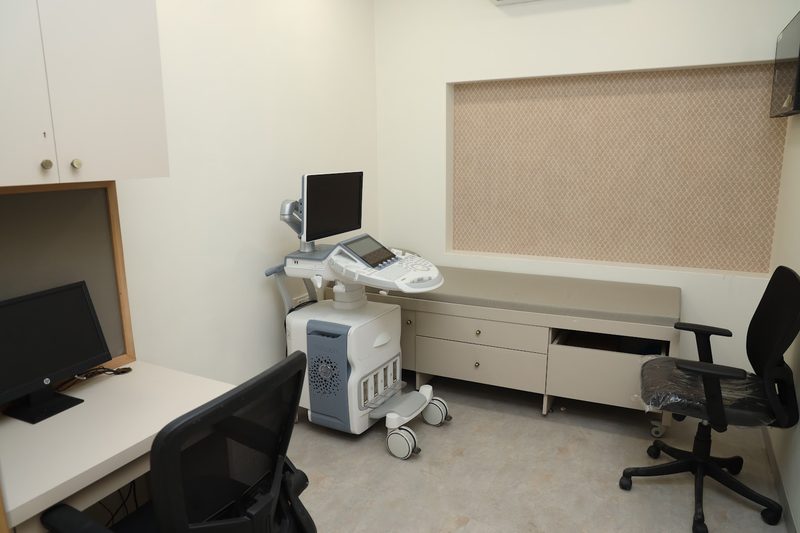
There is more than one way to measure liver stiffness: transient elastography uses a dedicated stand-alone device, while shear-wave elastography is built into an ultrasound machine. [5] At AV Scan we use shear-wave (ARFI) elastography on the ultrasound machine itself, so the radiologist sees your liver on the screen while measuring. It is similar in purpose to FibroScan.
Many guideline cut-offs come from transient elastography, which has been studied for longer. The European guideline accepts shear-wave elastography as an alternative, with its own cut-offs. [1] [5] Because the numbers from different methods and machines cannot be compared directly, it helps to repeat the same type of test for follow-up.
How is the liver stiffness test done at AV Scan?
Scans are performed on a doctor's prescription. Send a photo of your prescription on WhatsApp (opens WhatsApp), and our team confirms the tests, the preparation and the day. If your prescription asks only for an abdominal sonography and it shows fatty liver, the stiffness test can be added the same day, after a call to your referring doctor.
Before you come
Do not eat for about 4 to 6 hours beforehand: a meal can raise the reading [5], and fasting keeps the gallbladder easy to see. You can drink plain water freely. Take your regular medicines with a little water unless your doctor has told you otherwise. If you take insulin or diabetes tablets, tell us so the timing can be planned, and ask your own doctor about that morning's medicines. Avoid heavy exercise just before the test, and tell us about any alcohol in the past few days.
Before the scan
Wear loose, two-piece clothes, and bring your prescription, earlier sonography and elastography reports, and your liver and hepatitis blood tests. You rest quietly for a few minutes before the readings.
The sonography
The radiologist checks your liver, gallbladder, bile ducts and spleen, looking for fat and for signs of scarring.
The stiffness readings
You lie on your back with your right arm above your head. For each reading, you breathe normally, then hold your breath for a few seconds without taking a deep breath in. The probe presses only lightly.
The result
The report gives the middle value of several readings (in kPa or m/s), called the median, and how consistent they were. You can eat and carry on as normal straight away.
The stiffness readings take about 10 to 15 minutes, or about 30 to 40 minutes in all with the abdominal sonography.
What can make the stiffness reading wrong?
Other things besides scarring can stiffen the liver and make the reading falsely high: a recent meal, heavy exercise, a flare of hepatitis or other active inflammation (such as jaundice or very high liver enzymes), blocked bile ducts, congestion from heart failure, or recent heavy drinking. [5] [7] If the sonography shows widened bile ducts, your doctor may ask for an MRCP.
Severe obesity and narrow gaps between the ribs can make readings harder to get. [7] Shear-wave elastography can usually still be done when there is some fluid around the liver. [5] If the readings are not reliable enough, the report says so, and your doctor may suggest a repeat or another test. If you are pregnant, tell us when you book, because pregnancy can change the reading.
When do I get the report, and who explains it?
Your sonography and elastography are reported by our radiologists. Most reports the same day, sent to your WhatsApp. Your images come on a cloud link (or a DVD on request) along with your report. If there is an urgent finding, the radiologist contacts your doctor directly.
Lower values usually mean little or no scarring, and higher values point to more. Still, a single number is not a diagnosis, and elastography cannot show what caused the damage. Your own doctor reads the result with your blood tests and history, and decides what comes next.
More about the test is on our liver elastography page and our abdominal sonography page; every ultrasound test is listed on our sonography page.
What can I do about fatty liver?
Fatty liver often gets better when its causes are treated. If you are overweight, the European guideline says that losing at least 5% of your weight, and keeping it off, reduces liver fat, and losing 10% or more can improve scarring. [1] For someone who weighs 80 kg, 5% is 4 kg. The Indian guideline advises losing 7 to 10%. [3]
- Be active for at least 150 minutes a week at a moderate pace, such as brisk walking, or 75 minutes of harder exercise. [1] [6]
- Eat more vegetables, pulses, whole grains and nuts, and cut down on processed foods, sweets and sugary drinks. [1]
- Cut down on alcohol, and stop completely if you have advanced scarring or cirrhosis. [1]
- Keep your diabetes, blood pressure and cholesterol under control, and do not stop or change any medicine unless your doctor tells you to. [1]
- Ask your doctor before taking herbal or liver supplements: the European guideline does not recommend them, because there is not enough proof that they work or are safe. [1]
When should I see a doctor sooner?
- If your sonography report mentions an uneven liver surface, a large spleen, fluid in the abdomen or a lump in the liver, show it to your doctor soon rather than waiting for a routine check.
- If your FIB-4 score or stiffness result is raised, ask your doctor whether you should see a liver specialist. [1]
- If your eyes or skin turn yellow, or your tummy or legs swell, see a doctor urgently. [8]
This guide is about planned tests. If you vomit blood, pass very dark or black stools, suddenly become confused, or have yellow eyes or skin together with a high temperature, shivering or severe tummy pain, do not wait for a scan: go to the nearest hospital emergency department or call 108 or 112. [8] [9]
Frequently asked questions
Is grade 1 fatty liver serious?
Grade 1 means mild fat on sonography. Fat on its own does not predict serious liver problems; scarring does, and the grade cannot show it. Ask your doctor about a FIB-4 score and, if advised, a stiffness test. Fatty liver is also linked with diabetes and heart disease, so your sugar, blood pressure and cholesterol are worth checking too.
My SGPT is normal. Can my liver still be scarred?
Yes. Liver enzymes such as SGPT (ALT) and SGOT (AST) are often normal even when there is significant scarring, so guidelines advise against using them alone to rule it out. A FIB-4 score, followed by a stiffness test when needed, is a better check.
My prescription says FibroScan. Is your liver stiffness test the same?
Our shear-wave elastography is similar in purpose to FibroScan: it measures how stiff your liver is, to estimate scarring. Numbers from different methods are not directly comparable, so ask your doctor before comparing it with an earlier result. Our team can check your prescription on WhatsApp (opens WhatsApp).
Can the liver stiffness test also measure the fat in my liver?
Yes, in the same visit. Our ultrasound machine can also estimate how much fat is in your liver, while the stiffness reading itself estimates scarring. The sonography also grades the fat as mild, moderate or severe, although very mild fat may not show. Your doctor reads the fat and scarring results together.
Can fatty liver be reversed?
Often, yes. In people who are overweight, losing at least 5% of body weight and keeping it off reduces liver fat, and regular exercise helps too. In people of normal weight, diet and exercise are still advised to reduce liver fat. Your doctor can set targets with you.
How often should fatty liver be checked again?
If your FIB-4 score is low, the European guideline suggests repeating it every 1 to 3 years; the American guidance says every 1 to 2 years with diabetes, prediabetes or fatty liver on a scan. After a reassuring stiffness test, your doctor will tell you when to check again.
Can I have the liver stiffness test on a Sunday?
No. Elastography is an ultrasound test, and ultrasound tests are done Monday to Saturday, with evening appointments 6 pm onwards by prior booking, and never on a Sunday. Send your prescription on WhatsApp (opens WhatsApp), and our team will suggest a day and confirm the preparation.
Sources
- EASL–EASD–EASO Clinical Practice Guidelines on the management of metabolic dysfunction-associated steatotic liver disease (MASLD): Executive Summary. European Association for the Study of the Liver, European Association for the Study of Diabetes and European Association for the Study of Obesity; Diabetologia 67:2375–2392, 2024.
- AASLD Practice Guidance on the clinical assessment and management of nonalcoholic fatty liver disease. American Association for the Study of Liver Diseases; Rinella ME et al., Hepatology 77(5):1797–1835, 2023.
- Indian National Association for Study of the Liver (INASL) Guidance Paper on Nomenclature, Diagnosis and Treatment of Nonalcoholic Fatty Liver Disease (NAFLD). INASL; Duseja A et al., Journal of Clinical and Experimental Hepatology 13(2):273–302, 2023.
- Prevalence of Non-alcoholic Fatty Liver Disease in India: A Systematic Review and Meta-analysis. Shalimar et al., Journal of Clinical and Experimental Hepatology 12(3):818–829, 2022.
- EASL Clinical Practice Guidelines on non-invasive tests for evaluation of liver disease severity and prognosis – 2021 update. European Association for the Study of the Liver; Journal of Hepatology 75(3):659–689, 2021.
- Non-alcoholic fatty liver disease (NAFLD). NHS (nhs.uk), 2025.
- Elastography. RadiologyInfo.org (ACR and RSNA), 2024.
- Cirrhosis. NHS (nhs.uk), 2025.
- Gallstones. NHS (nhs.uk), 2025.
Related tests
Page updated
Book or ask a question
Visit us
AV Scan Diagnostics
Ground Floor, Shilpa Apartment, Shankar Ghanekar Marg, near Shivaji Park, Dadar West / Prabhadevi, Mumbai 400028
Dadar West / Prabhadevi, Mumbai, near Siddhivinayak Temple and Shivaji Park
Ground floor, step-free entrance
Landline 022-3522 0711
Opening hours
| Mon–Sat | 8:00 am – 10:00 pm |
|---|---|
| Sunday | 8:00 am – 5:00 pm |
Ultrasound: Monday to Saturday; evenings 6 pm onwards by prior appointment; no ultrasound on Sundays